Executive Summary
This article argues that Indigenous Peoples must be involved and recognized as active security actors in Canada’s Arctic rather than passive stakeholders. Despite official commitments to partnership, Indigenous participation remains largely consultative, which weakens both Canada’s legitimacy and security effectiveness in the region. Indigenous Peoples’ local presence and their knowledge make them essential to Arctic security, particularly in remote regions. Active participation for a more effective Arctic security policy can only be achieved through a combination of greater co-governance, greater financing of dual-use infrastructure and Indigenous self-determination.
Introduction
On March 12, 2026, the recently elected Canadian government announced a new large-scale investment plan in the Arctic which allocated 40 billion dollars to its defence. Its aim is to deter emerging threats and strengthen the continental defence of NATO and NORAD Allies in the North. Steven MacKinnon, Canadian Minister of Transport and Leader of the Government in the House of Commons, noted that “[…] we will work with Indigenous Peoples, governments, and industry proponents to build the dual-use airports […] opening new gateways to the world” (Prime Minister of Canada 2026).
This announcement reflects the growing importance of the Arctic as a strategic region, one which Canada has already framed as central to its sovereignty (Government of Canada 2019a), while also recognizing that Indigenous Peoples are an essential part of its governance (Government of Canada 2019b).
In theory, Canada advocates for a mutual partnership with Indigenous Peoples in the Arctic, following the principle of nothing about us without us (Government of Canada 2023). Nevertheless, Indigenous involvement in the Arctic has tended to be limited to a consultative role (Fouse 2025). Indigenous Peoples have almost no influence over the formulation and the decision-making processes for security and defence policies. This was notably demonstrated in a 2023 incident in which an object suspected of being a foreign surveillance balloon was shot down over First Nations’ territory in Yukon, causing confusion and revealing serious coordination flaws among Canadian authorities (Connors 2023).
Consultation informs decisions, and co-governance shapes them (Sivertsen 2025), but Indigenous Peoples tend to be excluded from substantive Arctic governance. This is a challenge in terms of representation but also a missed operational opportunity. Indigenous communities maintain a permanent presence across the Arctic and possess knowledge and situational awareness that are directly relevant to the region’s security. It is therefore important to reframe these resources as contributions to the shared governance of the Arctic’s security, in collaboration with the government of Canada.
The current Canadian government appears to be taking important steps toward better integrating Indigenous Peoples in Arctic governance, but it is important to recall why their role is so crucial in the region.
Literature on the topic often approaches Indigenous inclusion through a holistic lens. This paper reframes the discussion by focusing on Indigenous Peoples as active security actors. Among other sources, it draws on an interview conducted with Dr. Haliehana Stepetin to investigate how Canadian Indigenous communities can participate as strategic actors in Arctic security, and how this can align with broader Arctic NATO member objectives in mutually beneficial ways.
The rationale behind active Indigenous participation in Arctic security
From a high-level perspective, Canada has little interest in integrating Indigenous Peoples into its Arctic security strategies. Its main objectives are to consolidate its sovereignty over the Arctic region (Government of Canada 2026a) and to secure access to strategically important resources such as critical minerals and hydrocarbons (Jeanty and Sharma 2025).
The exclusion of these communities from the formulation of Arctic security and defence strategies (Fouse 2025) raises important issues. As highlighted by the NGO Inuit Tapiriit Kanatami (ITK 2025), exclusion from security decision-making processes risks undermining Canada’s governance legitimacy in the region. While public support alone does not guarantee the success of Canada’s security policy in the Arctic, a lack of engagement with Indigenous Peoples can undermine the effectiveness of Arctic policies (Fouse 2025).
Canada’s historical neglect of Inuit Nunangat has been structural. Taking the form of underinvestment, it has kept the region economically disadvantaged and directly contributed to structural fragilities (ITK 2025). In fact, it has created a hostile environment where foreign actors could exploit inequalities to serve their own interests, by using cyberattacks to exploit vulnerabilities in the region’s technological infrastructure (ITK 2025). Addressing these challenges therefore requires a strong partnership with Indigenous Peoples in the Arctic.
From this perspective, Indigenous Peoples should not be considered merely as key stakeholders to be consulted, but as partners whose knowledge, presence and traditions are essential to the development of new Arctic security approaches.
Indigenous Peoples as security actors in the Arctic
Indigenous Peoples’ presence and knowledge
Indigenous communities living in the Arctic contribute to regional security through their role as observers grounded in continuous presence on the land. Indeed, through their daily hunting, traveling and fishing activities, Indigenous Peoples develop sharp and extensive knowledge of the Arctic environment. This permanent presence supports forms of situational awareness that are valuable in areas where other surveillance systems remain limited.
Existing initiatives already reflect this idea. For example, 23% of the members of the Canadian Rangers, a Reserve Force unit responsible for monitoring coastal activities in the Arctic, identify as Indigenous (Government of Canada 2023). Similarly, 60% of Australia’s NORFORCE, a unit of the Australian Army Reserve, is Indigenous (Caso 2023). These examples illustrate how Indigenous Peoples’ presence can complement existing security structures.
As such, Indigenous Peoples in the Arctic are well positioned to contribute to early warning capacities in remote areas, notably by detecting suspicious or illegal activity, reporting environmental changes and other hazards (Stroud 2025).
More broadly, Indigenous Knowledge holds significant importance and relevance for Arctic security as Indigenous Peoples have long been at “the forefront of nature conservation, national defence as well as addressing climate disaster and risks through adaptation and mitigation strategies” (Stroud 2025). While the region presents unique challenges including extreme weather conditions, difficult terrain and limited infrastructure, Indigenous Knowledge can support safer navigation, help identify new travel routes and broadly support faster responses during emergencies (Stroud 2025).
However, this knowledge cannot be taken for granted. The intergenerational transmission of Indigenous Knowledge has been interrupted because of the effects of climate change, as the Arctic is warming four times faster than the rest of the world (Northern Arizona University 2025). Climate change has undermined self-determination and led to displacement, which in turn impacts the transmission of this knowledge. As a result, there is a risk of “losing a significant source of expertise that cannot be replicated through modern training or technology” (Stroud 2025).
The relevance of Indigenous presence and knowledge also extends to broader infrastructure systems that structure mobility and connectivity across the Arctic such as in dual-use infrastructure, which serves both defence priorities and the needs of Indigenous Peoples in the Arctic.
Indigenous Peoples’ participation as a pillar of integrated deterrence: the case of dual-use infrastructure
The concept of integrated deterrence recognizes that security cannot solely rely on military power. It also depends on close collaboration with Allies and partners (U.S. Department of Defense 2022). In the Arctic, this means security also depends on empowered local Indigenous communities. Inuit leaders support this logic, stating that Arctic security is inseparable from the well-being of Inuit communities (ITK 2025).
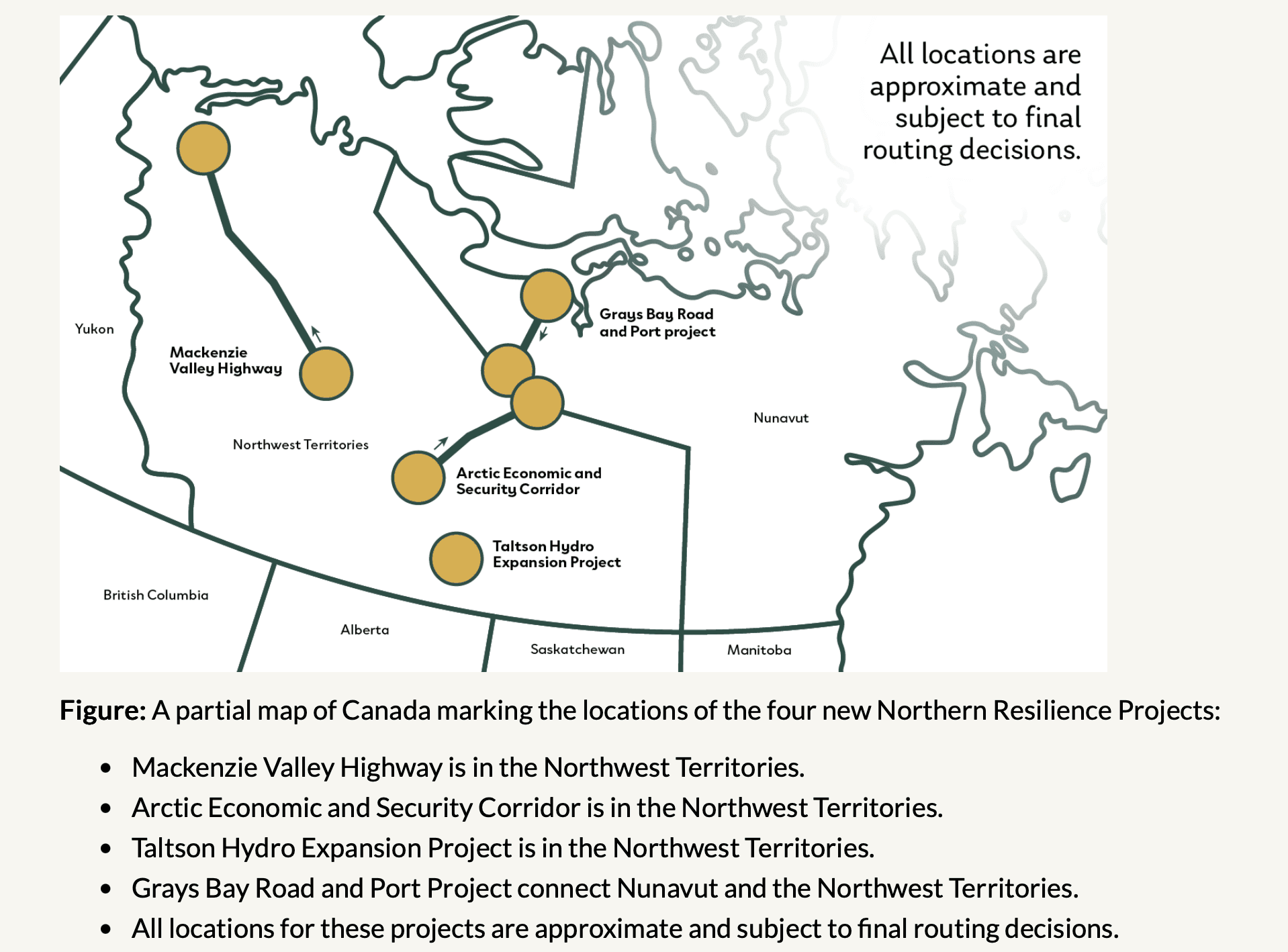
Infrastructure plays a central role in this understanding of security. Dual-use infrastructure, that is used for both civilian and defence objectives, can increase connectivity while also expanding defence capacities (ITK 2025). This is reflected in very recent Canadian Arctic policy adjustments: the government announced major investments in the Arctic airports of Rankin Inlet and Inuvik in March 2026. These investments will enable them to accommodate larger aircraft through lower-cost transportation options, thus improving accessibility and developing military mobility (Prime Minister of Canada 2026). The Canadian government has also announced it wants to build critical infrastructure, such as the Mackenzie Valley Highway (See Annex 1), a planned 800 km route linking Yellowknife and Inuvik, providing accessibility to Indigenous communities (Prime Minister of Canada 2026).
Similarly, the Grays Bay Road and Port project aims to connect Nunavut to the national road network through the Northwest Territories, creating Canada’s first land link to a deep-water port on the Arctic Ocean. The project includes a mineral export terminal and an airstrip designed for both civilian and military use. Another project, the proposed expansion of the Taltson hydroelectric facility, would add 60 megawatts of capacity to the current grid, doubling the Northwest Territories’ generation capacity and supporting approximately 70% of residents.
At the policy level, major federal infrastructure investment initiatives are increasingly embedded in a broader federal strategy aimed at consolidating Arctic sovereignty. Canada launched the Arctic Infrastructure Fund (AIF) in March 2026, a one-billion-dollar initiative supporting the construction and expansion of dual-use transportation infrastructure such as roads, railways, airports and bridges in the Arctic. This helps enhance defence capabilities and promote economic growth among Indigenous Peoples: a win-win outcome (Government of Canada 2026b) (See Annex 2).
Such infrastructure investment helps support a more substantive Arctic governance which also involves and reinforces governance structures and high levels of Indigenous participation.
Strengthening Indigenous participation in Arctic security: recommendations
Reinforcing Arctic security through this multi-pronged approach requires boosting Indigenous involvement across the board. This section draws deeply on insights from Dr. Haliehana Stepetin (Unangax̂, Qigiiĝun Tribe). Dr. Stepetin was born and raised in the village of Akutan, Alaska, in Unangam Tanangin [Aleutian Islands] and holds a PhD in Native American Studies from the University of California Davis. For her, strengthening Indigenous participation in Arctic security requires moving toward a trust-based collaboration grounded in Indigenous Knowledge systems and realities.
First, security planning and operations should be conducted in full partnership with Indigenous communities from the outset. This implies not only consultation, but alignment with the principle of “free, prior and informed consent” as outlined in Article 10 of the United Nations Declaration on the Rights of Indigenous Peoples (2007). In practice, it refers to the co-developing of military exercises, planning activities well in advance to build meaningful relationships, while ensuring Indigenous participation and prior consent.
Second, Indigenous Knowledge should be recognized as an essential component of operational effectiveness, not merely as a supplement. Indeed, Arctic environments present extreme weather conditions to which conventional military forces and technologies are not fully adapted. Partnerships with Indigenous communities can therefore foster the development of adapted technologies, such as with Arctic Indigenous outerwear like seal-skin technology, which provides a high level of thermal insulation (Barker et al. 2025).
Third, the development of dual-use infrastructure should prioritize the needs of Indigenous communities while supporting broader security objectives. Indeed, there are persistent gaps in connectivity and emergency response capabilities in Arctic regions (Stepetin, personal communication, 2026). Priorities therefore include establishing more fibre-optic networks and returning to communication methods such as high-frequency radio to prevent total outages during crises. For some coastal Indigenous communities, the construction of port infrastructure could offer opportunities for more affordable transportation of goods to Indigenous communities while serving as dual-use or critical infrastructure. However, such development must be initiated from within the communities themselves through processes grounded in free, prior and informed consent. This could take the form of co-designed infrastructure development processes, such as participatory digital platforms that enable Indigenous communities to contribute to project monitoring.
Finally, recognizing the significance of Indigenous self-governance is essential for Arctic security governance. In Nunavut, a Northern Canadian territory governed by Inuit institutions, decision-making rests with the People whose homelands are directly affected by security policies. Given that many Arctic regions have Indigenous majorities, strengthening these governance systems can enhance legitimacy and coordination on security matters. This could be achieved by granting greater budgetary authority to Indigenous-led governments.
Conclusion
Strengthening Indigenous Peoples’ participation in formulating security and defence policies in the Arctic is not only a normative commitment but also a strategic necessity for enhancing the region’s overall security. Canada has made more progress than certain other states, particularly through a process of historical engagement with the creation of the Truth and Reconciliation Commission (Stepetin, personal communication, 2026), dedicated to the documentation of the Residential Schools system in Canada (National Centre for Truth and Reconciliation, n.d.). This helps to address the issue from the ground up, which is essential to build durable cooperation in Arctic security. Finally, strengthening Indigenous Peoples’ participation is both a trust-building measure and a strategic imperative, as security in the Arctic is increasingly shaped by rivalry among major powers such as Russia and China.
Annex
Annex 1: Partial map of Canada marking the locations of the four Northern Resilience Projects
Annex 2: Map of Northern Canada showing transportation networks eligible under the AIF
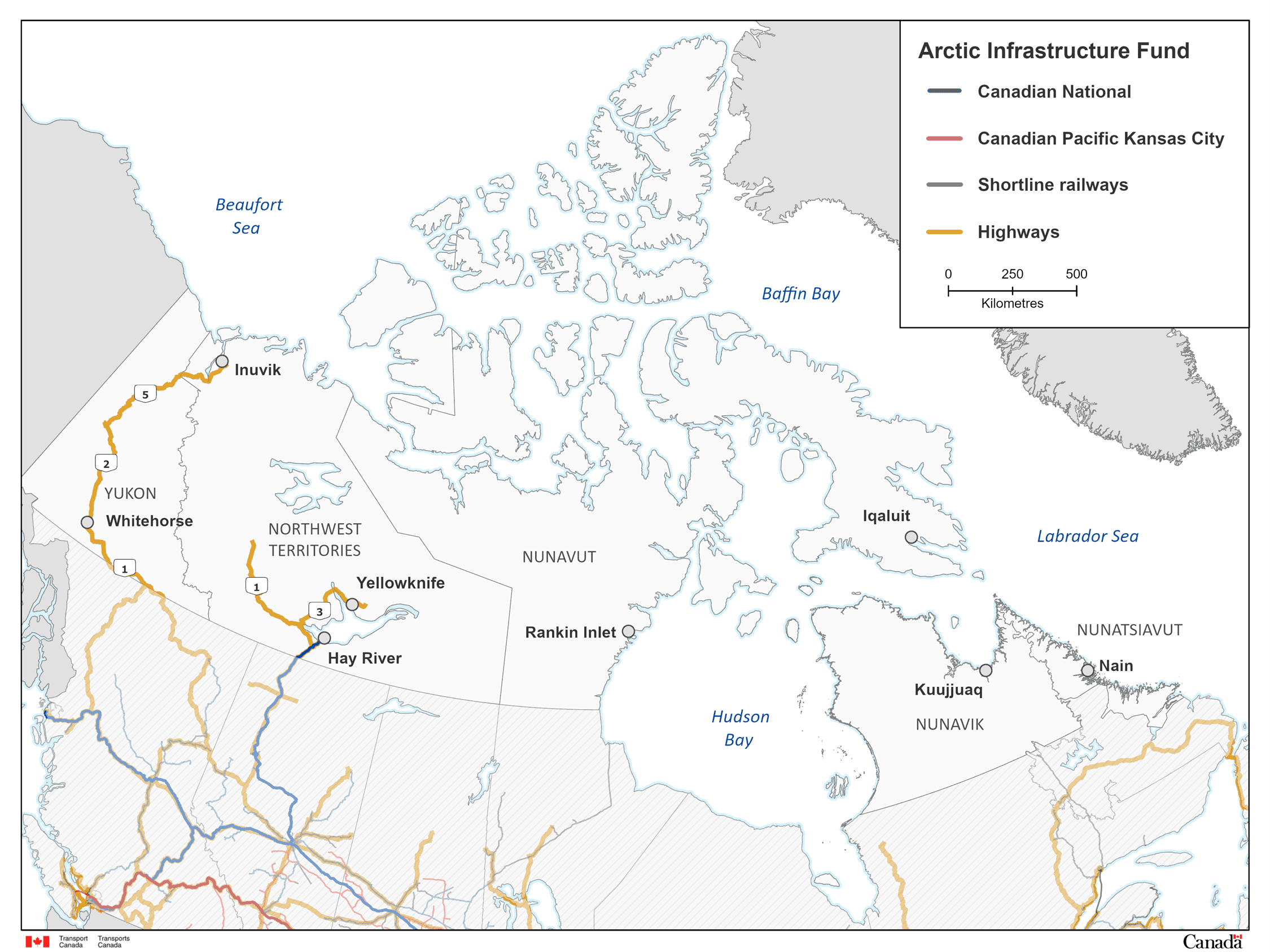
Source: https://tc.canada.ca/en/programs/funding-programs/arctic-infrastructure-fund
Bibliography
Andreeva, Serafima. 2026. “Why the Arctic Matters to Canada’s Security.” Fridtjof Nansen Institute. https://www.fni.no/publications/why-the-arctic-matters-to-canada-s-security
Barker, C. Anne, Jonathan T. Power, Autumn Schnell, and Melvin J. Mahar. 2025. “Evaluation of Indigenous Garments and Government of Canada Cold Weather Clothing Insulation: Growing Northern Economies through Safer Personal Protective Equipment.” FACETS 10: 1–16. https://doi.org/10.1139/facets-2024-0100
Binggeli, Mirjana. 2025. “Il ne peut y avoir de souveraineté arctique sans sécurité inuit : le Nunavut prend la tête du débat sur l’Arctique.” Polar Journal, July 9. https://polarjournal.net/fr/il-ne-peut-y-avoir-de-souverainete-arctique-sans-securite-inuit-le-nunavut-prend-la-tete-du-debat-sur-larctique/
Broek, Emilie, Nicholas Olczak, and Lisa Dellmuth. 2023. “The Involvement of Civil Society Organizations in Arctic Governance.” Stockholm International Peace Research Institute. https://doi.org/10.55163/nkqm8574
Canadian Indigenous Investment Forum. 2025. “Canada’s Dual-Use of Infrastructure and Strategic Investment.” October 30. https://canadianindigenousinvestmentforum.org/canadian-indigenous-investment-insights/indigenous-investment-canada/canadas-dual-use-infrastructure-strategic-investment-convergence-of-defence-and-economic-development
Caso, Frederica. 2023. “Defence’s Inclusion of Indigenous People in Australia, Canada, and New Zealand.” Australian Institute of International Affairs. https://www.internationalaffairs.org.au/australianoutlook/defences-inclusion-of-indigenous-people-in-australia-canada-and-new-zealand/
Cecco, Leyland. 2025. “Indigenous guides in the Arctic are training Canada’s military: ‘When they talk, I listen’.” The Guardian, March 19. https://www.theguardian.com/world/2025/mar/19/canada-indigenous-arctic-military
Connors, Sarah. 2023. “First Nations in Yukon looking for information on unidentified object.” APTN News, February 13. https://www.aptnnews.ca/national-news/first-nations-in-yukon-looking-for-information-on-unidentified-object/
Connors, Sarah. 2025. “First Nations in Yukon need to be more involved in Arctic security, defence says report.” APTN News, August 12. https://www.aptnnews.ca/national-news/first-nations-in-yukon-need-to-be-more-involved-in-arctic-security-defence-says-report/
Fouse, Ariane. 2025. “Who Holds the North? Indigenous Sovereignty and the Politics of Presence in Canada’s Arctic.” The McGill Journal of Political Science, November 17. https://mjps.ssmu.ca/who-holds-the-north-indigenous-sovereignty-and-the-politics-of-presence-in-canadas-arctic/
Government of Canada. 2019b. “Arctic and Northern Policy Framework.” Accessed May 9, 2026. https://www.rcaanc-cirnac.gc.ca/eng/1560523306861/1560523330587
Government of Canada. 2019a. “The Government of Canada Launches Co-Developed Arctic and Northern Policy Framework”. September 10. Accessed May 9, 2026. https://www.canada.ca/en/crown-indigenous-relations-northern-affairs/news/2019/09/the-government-of-canada-launches-co-developed-arctic-and-northern-policy-framework.html
Government of Canada. 2023. “Canadian Rangers.” April 24. Accessed May 9, 2026. https://www.canada.ca/en/department-national-defence/corporate/reports-publications/proactive-disclosure/secd-april-24-2023/canadian-rangers.html
Government of Canada. 2026a. “Arctic Infrastructure Fund.” Accessed May 9, 2026. https://tc.canada.ca/en/programs/funding-programs/arctic-infrastructure-fund
Government of Canada. 2026b. “Security, Sovereignty, Prosperity: Canada’s Defence Industrial Strategy.” Department of National Defence. Accessed May 9, 2026. https://www.canada.ca/en/department-national-defence/corporate/reports-publications/industrial-strategy/security-sovereignty-prosperity.html
Gricius, Gabriella. 2022. “Neo-Colonial Security Policies in the Arctic.” The Arctic Institute, September 13. https://www.thearcticinstitute.org/neo-colonial-security-policies-arctic/
Guidici, Nelly. 2025. “Redéfinir la défense du Nord avec les Premières Nations.” Médias Ténois, September 2. https://mediastenois.ca/arctique/2025/09/02/redefinir-la-defense-du-nord-avec-les-premieres-nations/
Howells, Olivia. 2025. “China, Rare Earth Elements, and the Arctic: Assessing Security Implications for Canada.” Centre for International Defence Policy, Policy Brief 10(2). https://www.queensu.ca/cidp/publications/policy-briefs/china-rare-earth-elements-and-arctic-assessing-security-implications
ITK. 2025. “An Inuit Vision for Arctic Sovereignty, Security and Defence.” https://www.itk.ca/wp-content/uploads/2025/06/An-Inuit-Vision-for-Arctic-Sovereignty-Security-Defence.pdf
Jeanty, Rinaldo, and Ranjana Sharma. 2025. “Canada’s Arctic: The Role and Responsibility of Natural Resources.” Canadian Science Policy Centre, November. https://sciencepolicy.ca/posts/canadas-arctic-the-role-and-responsibility-of-natural-resources/
Lackenbauer, P. Whitney, Zachary Zimmerman, and Samuel Pallaa Huyer. 2025. “Recent Canadian Northern Indigenous People’s Sovereignty, Security, and Defence Strategies.” Arctic Yearbook, 2025. https://arcticyearbook.com/arctic-yearbook/2025/2025-briefing-notes/578-recent-canadian-northern-indigenous-peoples-s-sovereignty-security-and-defence-strategies
Moyer, Jason C. 2025. “Prioritizing Canada’s Investment in Arctic Infrastructure.” Atlantic Council, December 23. https://www.atlanticcouncil.org/in-depth-research-reports/issue-brief/prioritizing-canadas-investment-in-arctic-infrastructure/
National Centre for Truth and Reconciliation. n.d. “Residential School History.” Accessed May 9, 2026. https://nctr.ca/education/residential-school-history/
Northern Arizona University. 2025. “An Arctic meltdown in accelerating global warming. How will we adapt?” The NAU Review, February 6. https://news.nau.edu/arctic-warming/
OCDE. 2022. “Dans l’Arctique norvégien, promouvoir la participation efficace et constructive des communautés autochtones”. November 7.” https://www.oecd.org/fr/publications/2021/09/ipac-policies-in-practice_1a65968e/promoting-effective-and-meaningful-engagement-of-indigenous-communities-in-norway-s-arctic-areas_0cf6c6df.html
Pressman, Natalie. 2024. “Local Indigenous communities key to Arctic security, experts say.” CBC News, December 10. https://www.cbc.ca/news/canada/north/local-communities-key-in-arctic-security-strategy-1.7406578
Prime Minister of Canada. 2026. “Prime Minister Carney announces ambitious new plan to defend, build and transform the North.” March 12. Accessed May 9, 2026. https://www.pm.gc.ca/en/news/news-releases/2026/03/12/prime-minister-carney-announces-ambitious-new-plan-defend-build-and
Sarkisian, Arty. 2025. “Give Inuit greater role in Arctic security or risk ‘malicious’ foreign investment: Obed.” Nunatsiaq News, November 21. https://nunatsiaq.com/stories/article/give-inuit-greater-role-in-arctic-security-or-risk-malicious-foreign-investment-obed/
Sivertsen, Mathias. 2025. “Indigenous Participation in Security Policy: A Human Rights Based Imperative”. North Atlantic Policy Forum, December 3. https://www.napforum.org/policy-briefs/indigenous-participation-in-security-policy-a-human-rights-based-imperative
Stroud, Abbey. 2025. “Guardians Of The Arctic: Indigenous Knowledge At The Core of Climate And Security Policy.” NATO Association, November 19. https://natoassociation.ca/guardians-of-the-arctic-indigenous-knowledge-at-the-core-of-climate-and-security-policy/
U.S. Department of Defense. 2022. 2022: National Defense Strategy of the United States of America. https://media.defense.gov/2022/Oct/27/2003103845/-1/-1/1/2022-NATIONAL-DEFENSE-STRATEGY-NPR-MDR.PDF
United Nations. 2007. United Nations Declaration on the Rights of Indigenous Peoples. https://www.un.org/development/desa/indigenouspeoples/wp-content/uploads/sites/19/2018/11/UNDRIP_E_web.pdf
Zimmermann, Zachary. 2025. “Demystifying Dual-use Infrastructure in Canada’s Arctic and North.” Yukon News, August 10. https://yukon-news.com/2025/08/10/opinion-demystifying-dual-use-infrastructure-in-canadas-arctic-and-north/
About the Author
Noa Stefani Szal is a French-German young professional interested in Arctic security and defence matters. She holds two master’s degrees from Sciences Po Strasbourg and the College of Europe and has previous work experience in economic intelligence and business diplomacy. Currently, she works at the German Marshall Fund of the United States and focuses on transatlantic relations and European security policy.