
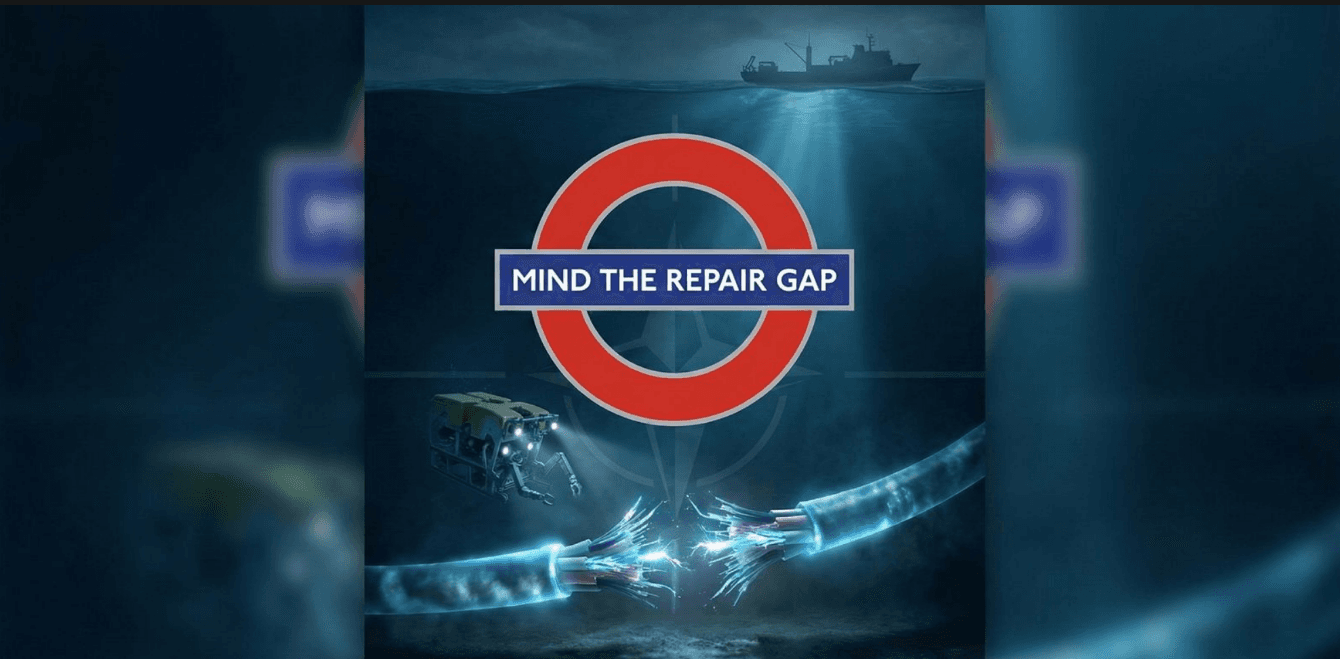
Submarine fibre-optic cables transmit 95% of transoceanic data traffic and carry USD $10 trillion in daily financial transactions, yet their security depends upon an ageing, commercially-operated repair fleet ill-suited to hybrid warfare (Mauldin and Constable 2025). Analysis demonstrates that 65% of cable maintenance vessels will reach end-of-life within 15 years, whilst average repair times have increased from between 10 to 20 days in 2015 to roughly 40 days in 2023 (Submarine Networks 2025). Investment in replacement capacity remains negligible despite USD $3 billion in investment being required to maintain current service levels through 2040 (TeleGeography 2025).
Simultaneously, the threat landscape is transforming from accidental damage to hybrid sabotage. Between November 2024 and January 2025, seven submarine cables were severed in the Baltic Sea in what Finnish, Swedish, and German authorities assess as deliberate operations linked to Russian “shadow fleet” vessels (European Policy Centre 2025). The Christmas Day 2024 severing of the Estlink 2 power cable by the vessel Eagle S, whose crew were subsequently charged by Finnish prosecutors with aggravated sabotage, represents a clear escalation (Submarine Networks 2025).
This brief presents three recommendations. Recommendation A is to establish NATO Naval repair units with military escort provisions and legal authority to operate in contested zones. Recommendation B is to implement the “Northwood Protocol”, mandating the adoption of interoperable splicing equipment and shared spare parts inventories for cables critical to NATO members and allies. Recommendation C is to create Strategic Shipbuilding Subsidies to co-fund Ice-Class repair vessel construction in Allied shipyards.
Analysis of Current Policy
Currently, cable repairs function through Private Maintenance Agreements (PMAs), of which the Atlantic Cable Maintenance Agreement, most relevant to NATO, comprises nearly 60 member organisations funding repair vessels positioned at strategic depots (Atlantic Council 2025). Whilst adequate for managing routine cable faults, which account for 86% of approximately 200 annual global cable incidents, this model wasn’t designed for the stress and urgency of hybrid warfare (Submarine Networks 2025).
First, standard PMA contracts include force majeure clauses, meaning commercial operators have no legal obligation to enter contested waters or prioritise national security repairs over commercial queue priorities. During grey-zone escalation, commercial operators would almost certainly invoke these clauses to avoid liability exposure. Secondly, PMAs operate on consensus-based decision-making allocating repair priority through commercial arbitration rather than strategic necessity. Thirdly, the majority of dedicated repair vessels operate under flags of convenience or neutral jurisdictions, complicating their employment in support of NATO military operations (Lieber Institute 2024).
Industry analysis reveals that 80% of purpose-built cable vessels were commissioned more than 20 years ago, with six vessels having surpassed 40 years of service (Mauldin and Constable 2025). Replacement investment has been negligible, stemming from perverse economic incentives. A modern repair vessel costs USD $100–150 million yet generates limited revenue through standby fees and repair call-outs. During the November 2024 Baltic incidents, it took several weeks for the C-Lion1 cable linking Finland and Germany to be restored (European Policy Centre 2025).
The historical assumption that damage results primarily from accidental causes no longer reflects operational reality, as demonstrated by the October 2023 Balticconnector incident, that saw the vessel Newnew Polar Bear deliberately drag its anchor across a 90-kilometre track, striking multiple infrastructure targets in succession (Atlantic Council 2025). On 17–18 November 2024, the BCS East-West Interlink and C-Lion1 cables were severed in near-simultaneous incidents that German Defence Minister Boris Pistorius characterised as “sabotage” (Braw 2024). The Christmas 2024 severing of Estlink 2 by Eagle S exposed critical gaps in NATO’s maritime domain awareness and in its legal authority to interdict suspect vessels (Submarine Networks 2025).
Policy Recommendations
Recommendation A: Establish a Standing NATO Maritime Group for Cable Repair (SNMG-C).
NATO should establish dedicated naval repair capabilities modelled on existing Standing Naval Forces but optimised for subsea infrastructure protection. SNMG-C would comprise purpose-built vessels operated under Allied flags with NATO MARCOM coordination authority, employing dual-use manning models with civilian crews augmented by military communications specialists during crises (NATO Allied Maritime Command 2025).
Implementation would follow a multinational consortium model, with lead nations (UK, Norway, Germany) each acquiring one Ice-Class repair vessel with NATO common funding providing 50% capital costs and coordinating technical specifications. Pre-negotiated PMA charter agreements would ensure financial sustainability during peacetime. This would address current limitations by creating vessels with explicit crisis mobilisation authority, whilst maintaining commercial efficiency during routine operations.
Recommendation B: Implement the “Northwood Protocol” for Allied-Critical Infrastructure.
NATO should mandate technical interoperability standards for cables designated as Allied-Critical Infrastructure, modelled on ammunition standardisation agreements (STANAGs). The Protocol would require interoperable splicing equipment across designated cables allowing any repair vessel to service any Allied system, shared spare cable inventories pre-positioned at NATO depots, and coordinated repair vessel tasking during Article 5 contingencies.
This recommendation addresses the technical fragmentation that currently prevents rapid cross-system repairs. During multi-cable incidents like the November 2024 Baltic disruptions, standardised equipment would enable any available vessel to commence repairs immediately rather than awaiting system-specific resources.
Recommendation C: Create Strategic Shipbuilding Subsidies for Allied Repair Fleet Renewal.
Allied governments should establish a sovereign vessel construction programme offering 50–70% capital subsidies for Ice-Class repair vessels built in Allied shipyards and operated under Allied flags.
Construction contracts would be awarded to Allied shipyards with naval expertise, such as Cammell Laird or Harland & Wolff (UK), Vard Group (Norway), and Remontowa Shipbuilding (Poland). This directly addresses private sector unwillingness to invest in replacement capacity whilst sustaining sovereign industrial capacity for maritime engineering.
Conclusion
The North Atlantic’s submarine cable infrastructure represents a massive vulnerability that adversaries have demonstrated both intent and capability to exploit. The current reliance upon ageing, commercially-operated repair vessels operating under peacetime contractual frameworks is strategically untenable in an environment where grey-zone hybrid operations deliberately target critical infrastructure below the threshold of armed conflict (Monsees 2024).
The policy recommendations—advanced SNMG-C establishment, the Northwood Protocol, and Strategic Shipbuilding Subsidies—collectively address the Repair Gap through sovereign capability development, technical standardisation, and sustained industrial capacity. The estimated total investment of GBP £2–3 billion over the next decade is modest relative to existential risks posed by degraded transatlantic communications, especially during Article 5 crises.
These recommendations do not require new treaty authorities or fundamental changes to NATO’s strategic concept. They represent new applications of existing Alliance frameworks adapted to the unique demands of subsea critical infrastructure protection (NATO 2025). Implementation can commence immediately through MARCOM coordination, with initial SNMG-C operational capability achievable by 2028 if construction contracts are awarded in 2026.
The alternative, which is continued dependence upon a declining commercial repair fleet, presents wholly unacceptable risks to Alliance cohesion and transatlantic financial stability. The Baltic Sea incidents of 2023–2025 have demonstrated that adversaries view submarine cables as legitimate targets for hybrid coercion (European Policy Centre 2025). NATO’s response must go beyond enhanced surveillance, creating sovereign repair capacity capable of operating in contested environments during the moments when Alliance resilience is most critical.
Bibliography
Atlantic Council. 2025. “How the Baltic Sea Nations Have Tackled Suspicious Cable Cuts.” Issue Brief, November. https://www.atlanticcouncil.org/in-depth-research-reports/issue-brief/how-the-baltic-sea-nations-have-tackled-suspicious-cable-cuts/.
Braw, Elisabeth. 2024. “Suspected Sabotage by a Chinese Vessel in the Baltic Sea Speaks to a Wider Threat.” Atlantic Council, November 21. https://www.atlanticcouncil.org/blogs/new-atlanticist/suspected-sabotage-by-a-chinese-vessel-in-the-baltic-sea-speaks-to-a-wider-threat/.
European Policy Centre. 2025. “Battle of the Baltic: Safeguarding Critical Undersea Infrastructure.” Policy Brief. https://www.epc.eu/publication/Battle-of-the-Baltic-Safeguarding-critical-undersea-infrastructure-645780/.
Lieber Institute for Law and Land Warfare. 2024. “The Baltic Sea Cable-Cuts and Ship Interdiction: The C-Lion1 Incident.” West Point, November 26. https://lieber.westpoint.edu/baltic-sea-cable-cuts-ship-interdiction-c-lion1-incident/.
Mauldin, Alan, and Mike Constable. 2025. “Current State and Forecasts for Submarine Cable Maintenance.” TeleGeography Research Report, October 14. https://blog.telegeography.com/current-state-forecasts-submarine-cable-maintenance.
Monsees, Linda. 2024. “The Paradox of Semiconductors EU Governance between Sovereignty and Interdependence.” Cambridge Review of International Affairs 37(1): 29–40.
NATO. 2025. “NATO’s Maritime Activities.” Topic Overview. https://www.nato.int/en/what-we-do/operations-and-missions/natos-maritime-activities.
NATO Allied Maritime Command. 2025. “Securing the Seas: How NATO Will Deliver Its Next-Generation Maritime Strategy.” Press Release. https://mc.nato.int/media-centre/news/2025/securing-the-seas-how-nato-will-deliver-its-nextgeneration-maritime-strategy.
Submarine Networks. 2025a. “Finland Charges Russian-Linked Ship Officers Over Baltic Sea Cable Sabotage.” August 13. https://www.submarinenetworks.com/en/nv/insights/finland-charges-russian-linked-ship-officers-over-baltic-sea-cable-sabotage.
Submarine Networks. 2025b. “Statistics on Subsea Cable Fault and Repair.” June 28. https://www.submarinenetworks.com/en/nv/insights/statistics-on-subsea-cable-fault-and-repair.
TeleGeography. 2025. “It’s Going to Take $3 Billion to Ensure Submarine Cable Repair Ships Can Keep the World Connected.” Blog Post, August 15. https://blog.telegeography.com/submarine-cable-maintenance-data.
Thomas Hollands is a British MA graduate of Diplomacy & Global Governance studies in Brussels. Currently serving as an EU Public Affairs Trainee at Stenstrom Conuslting, he is interested in diplomacy and global affairs, and has expertise in linguistics and culture.
He can be contacted through his LinkedIn:
🔗 https://www.linkedin.com/in/thomas-hollands-32b1b2230/