
Introduction: The Arctic as an Emerging Strategic Frontier
The Arctic is gaining prominence as a region of intensifying geopolitical and geo-economic competition. Climate change is transforming the High North at an unprecedented pace, with the region warming three to four times faster than the global average (OSCE PA 2025). As sea ice retreats and permafrost thaws, previously inaccessible energy and mineral resources are becoming more attainable, while new maritime routes are gradually opening across the Arctic Ocean (Knapp 2026). These developments are reshaping the region’s strategic significance and drawing growing attention from global powers.
European policymakers have recognised the scale of these changes. The European Union’s Arctic special envoy, Claude Véron-Réville, has observed that the region is undergoing “profound changes,” characterised by rising geopolitical tensions and geo-economic competition linked to its strategic location (Knapp 2026). The Arctic’s resource potential is playing a growing role in debates on economic security. In 2023, Sweden’s then energy minister Ebba Busch argued that the European Union’s future self-sufficiency from Russia and China could “begin in the Arctic mine,” referring to the northern Swedish town of Kiruna - home to Europe’s largest known iron ore deposit as well as significant rare earth resources (Bye 2023).
Hybrid Threats in the Arctic
Simultaneously, the Arctic is experiencing a growing level of securitisation. Once widely perceived as a region characterised by peaceful cooperation and scientific collaboration, the High North is now witnessing a greater military presence, rising competition over critical infrastructure, and intensified interest in its largely untapped natural resourcesIt includes rare earth minerals, hydrocarbons and newly accessible shipping routes made possible by retreating sea ice (OSCE PA 2025).
Russia has recently conducted major military exercises in the region, including sealing off large parts of the Barents Sea. Some of those exercises were conducted within Norway’s exclusive economic zone, like the Zapad-2025 exercises with Belarus, which included practising cruise missile launches over the Arctic (Bego 2025). NATO’s recent enlargement with the accession of Finland and Sweden has further reshaped the regional security landscape. As a result, the Alliance now includes seven of the eight Arctic states, a shift that the Kremlin has framed as a form of “hostile encirclement.” On 28 July 2025, NATO’s multinational Standing NATO Maritime Group One (SNMG1) was deployed to patrol the Norwegian and Barents Seas in order to safeguard key sea lines of communication and respond to growing maritime security concerns (Nilsen 2025).
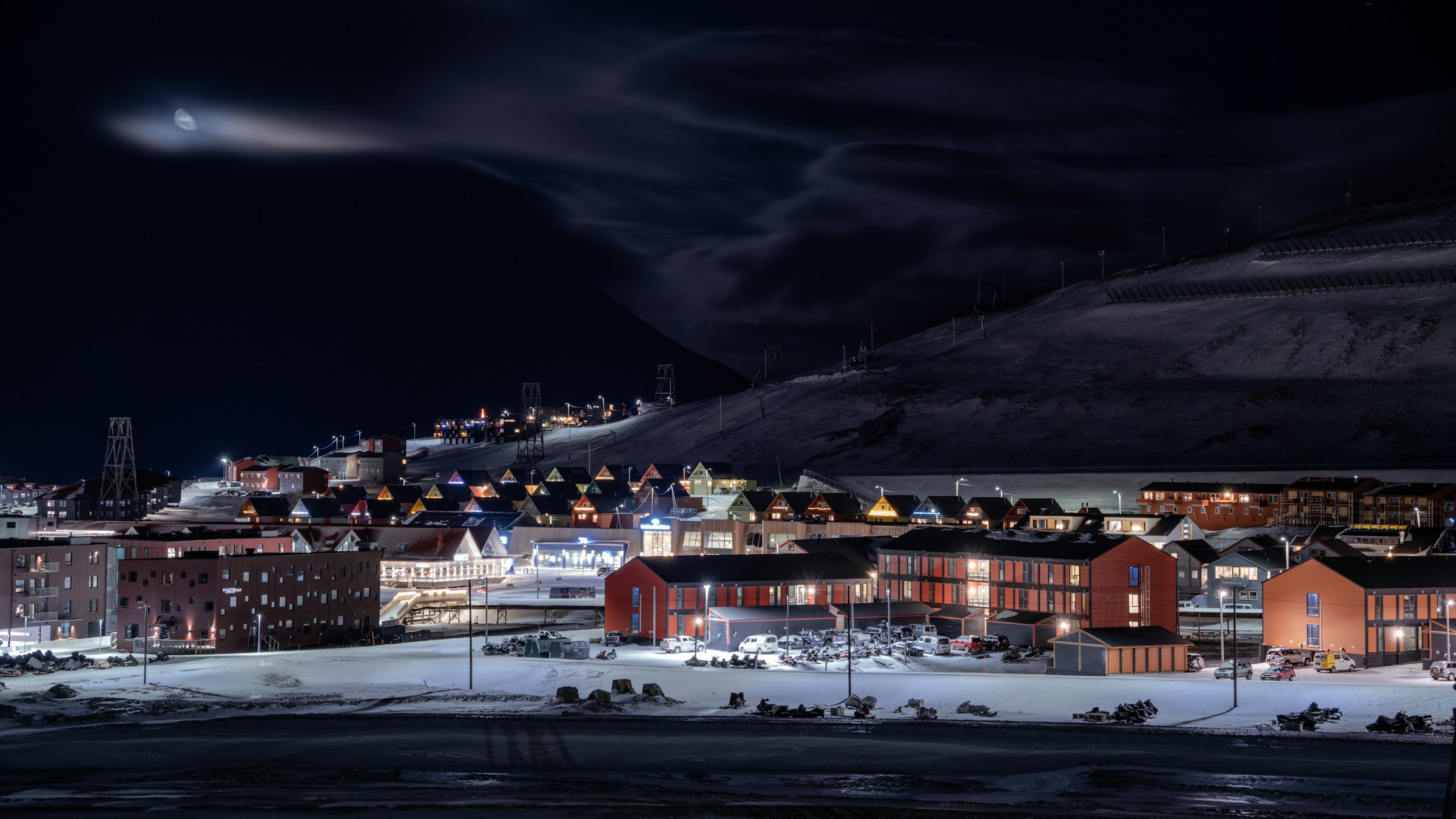
Beyond its conventional military posture, Moscow has increasingly relied on hybrid tactics to advance its interests in the Arctic. One notable example is Svalbard, a Norwegian archipelago where Russia retains the legal right to maintain settlements and conduct mining activities under the 1920 Svalbard Treaty (Arctic Portal 1920). Located just north of the Kola Peninsula and near the strategically important “Bear Gap”, a key maritime corridor for vessels exiting the Barents Sea, the archipelago has become a focal point of Russian grey-zone activity (Ditrych 2025). This activity ranges from symbolic demonstrations intended to project Russia’s historical and “civilisational” presence in the Arctic–such as Immortal Regiment marches or the installation of Orthodox symbols in Pyramiden–to more overtly provocative initiatives involving Russian officials and representatives of the state-owned mining company Arktikugol (Ditrych 2025). Often carefully staged and widely disseminated through media channels, such activities serve both propaganda and signalling purposes while subtly probing Norwegian responses.
Hybrid pressure is also visible in the maritime domain through Russia’s so-called “shadow fleet,” used to circumvent Western sanctions. In July 2025, the European Union adopted one of its strongest sanctions packages against Russia, targeting dozens of vessels, companies and individuals involved in sanctions evasion (European Council 2025).
“The EU just approved one of its strongest sanctions packages against Russia to date. Each sanction weakens Russia's ability to wage war. The message is clear: Europe will not back down in its support for Ukraine. The EU will keep raising the pressure until Russia ends its war (European Council 2025).”
According to EU High Representative for Foreign Affairs and Security Policy Kaja Kallas, the measures aim to weaken Russia’s ability to finance its war against Ukraine. Several tankers involved in transporting Russian Arctic oil were included in the sanctions list, such as the Matari and the Yanhu, both of which have operated in the Barents Sea and called at ports near Murmansk (Staalesen 2025). The Yanhu has repeatedly changed its name, flag state and ownership structure which fits into common tactics used to obscure the identity of vessels involved in sanctions evasion. Other sanctioned vessels include the LNG carriers Arctic Mulan and Pearl, which have participated in transshipment operations near the Kola Peninsula. Maritime monitoring indicates that dozens of sanctioned tankers continue to shuttle along the northern Norwegian coast on routes to Murmansk, raising growing concerns about maritime safety and security in the region (Staalesen 2025).
Polar Silk Road
Following Russia’s full-scale invasion of Ukraine in 2022, Moscow has further intensified its military and economic activities in the Arctic. These developments include the refurbishment of Soviet-era bases, the deployment of advanced weapons systems such as hypersonic missiles, and the continued strengthening of the Northern Fleet. At the same time, Russia has sought to accelerate the development of its Arctic natural resources. However, the region’s harsh climatic conditions make exploration and infrastructure projects costly and technically challenging. Western sanctions and the withdrawal of Western companies from Arctic projects after 2022 have therefore increased Russia’s reliance on Chinese investment and technological cooperation (Krishnan 2026). In this context, cooperation with China has become particularly important for the development of infrastructure along the Northern Sea Route (NSR), as well as for liquefied natural gas (LNG) exports from the Yamal Peninsula, further intensifying strategic competition with the United States and its allies (Krishnan 2026).
Russia’s growing dependence on China has also reinforced cooperation around the so-called Polar Silk Road. First proposed in 2017 as part of China’s Belt and Road Initiative (BRI), the concept, sometimes described as a “Silk Road on Ice”, envisions the development of Arctic shipping routes linking Asia and Europe through the Northern Sea Route (Xinhua 2017). Chinese officials have promoted this route as a means of significantly reducing shipping distances, potentially shortening maritime trade routes by 30-50 percent compared with traditional passages via the Suez Canal (Xinhua 2017). The initiative gained renewed political attention in February 2022, when Xi Jinping and Vladimir Putin met in Beijing shortly before Russia’s full-scale invasion of Ukraine and discussed expanding bilateral cooperation in the Arctic (Lamazhapov, Stensdal, and Heggelund 2023).
Since then, China has continued to signal support for its strategic partnership with Moscow. However, references to the Polar Silk Road have appeared less frequently in official Chinese rhetoric, raising questions about how central the initiative remains within China’s broader Arctic strategy. While the concept once generated considerable expectations, often portrayed in Chinese media as a potential “golden waterway” linking Asia and Europe, its precise role within Beijing’s wider global infrastructure ambitions remains uncertain (Lamazhapov, Stensdal, and Heggelund 2023).
U.S. Strategic Interests in the Arctic: The Case of Greenland
Moscow and Beijing are not the only actors turning their attention to the Arctic. In early 2026, the administration of President Donald Trump revived a proposal first raised during his earlier presidency: that the United States should acquire Greenland, ostensibly for reasons of national security (Wolff 2026). The suggestion was swiftly rejected by Danish and Greenlandic leaders. Danish Prime Minister Mette Frederiksen and Greenlandic Prime Minister Jens-Frederik Nielsen emphasised that Greenland’s sovereignty is not negotiable and that decisions regarding the island’s future must ultimately be made by its own population (Wolff, 2026). Frederiksen further warned that any attempt by the United States to seize Greenland militarily could effectively mark the end of NATO, reflecting the alarm felt across European capitals and the strain placed on the transatlantic alliance (Haesebrouck 2026).
“But I will also make it clear that if the U.S. chooses to attack another NATO country militarily, then everything stops, including NATO and thus the security that has been established since the end of the Second World War,” stated Frederiksen (Starcevic 2026).
Following these developments, Denmark and several European allies deployed reconnaissance teams to Greenland ahead of the Danish-led NATO exercise Arctic Endurance, aimed at strengthening Arctic security cooperation. In response, Trump threatened tariffs against Denmark and other European countries involved in the initiative (Litwiński 2026). Across Europe, these actions were widely interpreted as economic pressure and raised concerns that Washington might consider more coercive measures should diplomatic efforts fail. European leaders responded by reiterating that Greenland’s sovereignty is non-negotiable, issuing joint statements affirming that the island’s future must be determined by its own population.
It is important to recognise that the renewed American focus on Greenland does not emerge from a vacuum. For decades, US defence planners have viewed the island as a key element of North American security architecture, particularly for missile warning, space surveillance and monitoring military activity across the Arctic. Greenland’s location near the GIUK gap and its potential reserves of critical minerals further reinforce its strategic relevance in US’ strategic thinking (Litwiński 2026). Nevertheless, while these considerations explain Washington’s interest in the island, they do not necessarily justify calls for direct control over the territory.
The rationale behind acquiring the world’s largest island remains rather questionable. The United States already maintains military access to Greenland through a defence agreement signed with the Kingdom of Denmark in 1951, which was later updated in 2004 to include Greenland’s own government (Busch 2026). If Washington’s primary objective were to strengthen the defence of Greenland and the Arctic approaches to North America, it could simply expand its existing military presence under these arrangements. What is more, American sovereignty would not necessarily make Greenland’s mineral resources easier to exploit. Although Nuuk welcomes foreign investment, the island’s extreme climate, limited infrastructure and high operational costs make mining projects difficult to develop (Busch 2026).
Implications for the European Union
While seeking to limit Russia’s influence in the Arctic and closely monitor China’s growing ambitions in the region, the European Union must also take into account potential shifts in U.S. policy. Recent discussions in Washington, ranging from renewed interest in acquiring Greenland to the possibility of future cooperation with Russia on Arctic energy exploration illustrate how fluid the geopolitical landscape of the High North has become (Ditrych 2025). Although a significant rapprochement between Washington and Moscow appears unlikely in the near term, even limited cooperation could alter the balance of influence in the Arctic. In this context, the EU’s Arctic policy cannot remain confined solely to climate action and environmental protection. While these priorities remain central, the Union must increasingly address the region’s evolving geopolitical and security dynamics.
Recent statements by European Commission President Ursula von der Leyen suggest that Brussels is beginning to acknowledge this shift. Speaking in early 2026, von der Leyen stressed that the Arctic and its security “matter enormously” for the European Union, while reaffirming the bloc’s political, economic and financial support for Greenland (Sheftalovich 2026). Brussels has also signalled its intention to increase investment in Greenland and the wider Arctic region, while continuing to work with NATO allies on strengthening Arctic security. As von der Leyen noted, Greenland can “count on us politically, economically and financially,” reflecting the EU’s effort to demonstrate solidarity with Denmark and reaffirm the importance of stability in the High North (Sheftalovich 2026).
At the same time, the European Union faces the challenge of balancing several objectives in the region. On the one hand, the EU continues to position itself as a leading actor in climate governance and sustainable development in the Arctic. On the other hand, growing geopolitical competition, including increased military activity and strategic interest in Arctic resources and shipping routes, requires a more comprehensive strategic approach. Strengthening cooperation with Arctic partners such as Norway, Iceland and Canada, while coordinating closely with NATO allies, will therefore remain essential for safeguarding European economic and security interests in the region.
Conclusion
The Arctic is steadily transforming into one of the most significant geo-economic and strategic theatres of the twenty-first century. Climate change is not only reshaping ecosystems but also altering patterns of access, trade and resource extraction, drawing greater attention from global powers. Russia’s military posture, China’s economic engagement and the renewed strategic interest of the United States illustrate how the region is becoming embedded in broader dynamics of great-power competition. For the European Union, this evolving landscape raises questions about whether the priorities set out in its 2021 Arctic strategy remain sufficient for the current geopolitical environment (EEAS 2021). While the EU has traditionally approached the Arctic primarily through the lens of climate action, environmental protection and sustainable development, the region’s growing strategic significance requires a broader perspective that also takes into account security, economic resilience and geopolitical stability. Navigating these overlapping priorities will be essential as the Arctic continues to transform into an increasingly contested, yet still highly interdependent, strategic space.
Bibliography
Arctic Portal. 1920. “1920 Svalbard Treaty.” Library Arctic Portal. February 1920. https://library.arcticportal.org/1909/1/The_Svalbard_Treaty_9ssFy.pdf.
Bego, Katja . 2025. “Russia and China are Expanding in the Arctic: Europe Needs a New Plan for the Region.” Chatham House. October 3, 2025. https://www.chathamhouse.org/2025/10/when-it-comes-arctic-security-europe-must-not-forget-about-economics.
Busch, Aslak Veierud. 2026. “To Become a True Arctic Power, the US Should Follow the EU’s Example.” The Loop. February 4, 2026. https://theloop.ecpr.eu/to-become-a-true-arctic-power-the-us-should-follow-the-eus-example/.
Bye, Hilde-Gunn. 2023. “Europe’s Largest Deposit of Rare Earth Metals Found in Northern Sweden.” High North News. January 13, 2023. https://en.highnorthnews.com/business/europes-largest-deposit-of-rare-earth-metals-found-in-northern-sweden/157075.
Ditrych, Ondrej. 2025. “The Northern Frosts: The EU Should Contain and Unpower Russia in the Arctic.” European Union Institute for Security Studies. October 30, 2025. https://www.iss.europa.eu/publications/analysis/northern-frosts-eu-should-contain-and-unpower-russia-arctic#toc-two-cs-for-the-eu-s-more-strategic-engagement.
EEAS. 2021. “Joint Communication on a Stronger EU Engagement for a Peaceful, Sustainable and Prosperous Arctic.” European External Action Service. October 13, 2021. https://www.eeas.europa.eu/eeas/joint-communication-stronger-eu-engagement-peaceful-sustainable-and-prosperous-arctic_en.
European Council. 2025. “Russia’s War of Aggression against Ukraine: EU Adopts 18th Package of Economic and Individual Measures.” Consilium. July 18, 2025. https://www.consilium.europa.eu/en/press/press-releases/2025/07/18/russia-s-war-of-aggression-against-ukraine-eu-adopts-18th-package-of-economic-and-individual-measures/.
Haesebrouck, Tim. 2026. “Navigating the Greenland Crisis: Europe’s Imperfect but Viable Options.” Egmont Institute. January 9, 2026. https://egmontinstitute.be/navigating-the-greenland-crisis-europes-imperfect-but-viable-options/.
Knapp, Ferdinand. 2026. “Von Der Leyen to Visit Greenland as EU Shores up Arctic Presence.” POLITICO. February 19, 2026. https://www.politico.eu/article/ursula-von-der-leyen-confirms-greenland-trip-as-eu-shores-up-arctic-presence/.
Krishnan, S. 2026. “SOVEREIGNTY OF GREENLAND, GEOPOLITICS IN ARCTIC SECURITY AND INTERNATIONAL LAW.” Indian Journal of Legal Review 6 (1): 552. https://doi.org/10.65393/xxag6917.
Lamazhapov, Erdem, Iselin Stensdal, and Gørild Heggelund. 2023. “China’s Polar Silk Road: Long Game or Failed Strategy?” The Arctic Institute - Center for Circumpolar Security Studies. November 14, 2023. https://www.thearcticinstitute.org/china-polar-silk-road-long-game-failed-strategy/.
Litwiński, Patryk . 2026. “Greenland as a Stress Test of Transatlantic Trust: European Security Sentiments in the Trump Era.” Casimir Pulaski Foundation. February 10, 2026. https://pulaski.pl/en/greenland-as-a-stress-test-of-transatlantic-trust-european-security-sentiments-in-the-trump-era/.
NATO. 2024. “Partnerships and Cooperation: Relations with Finland.” North Atlantic Treaty Organization. October 3, 2024. https://www.nato.int/en/what-we-do/partnerships-and-cooperation/relations-with-finland.
Nilsen, Thomas. 2025. “NATO Group Sailed the Barents Sea as Russia Launched Multiple Missiles in Exercise.” The Barents Observer. July 31, 2025. https://www.thebarentsobserver.com/security/nato-group-sailed-the-barents-sea-as-russia-launched-multiple-missiles-in-exercise/434170.
OSCE PA. 2025. “Arctic at the Crossroads - Annual Report of the Special Representative on the Arctic and High North the Rt Hon Mark Pritchard MP.” Organization for Security and Co-operation in Europe Parliamentary Assembly. 2025. https://www.oscepa.org/en/documents/annual-sessions/2025-porto/reports-and-speeches-12/5299-arctic-at-the-crossroads-annual-report-of-the-special-representative-on-the-arctic-and-high-north/file.
Sheftalovich, Zoya . 2026. “Arctic ‘Matters Enormously’ to EU, von Der Leyen Says.” POLITICO. January 15, 2026. https://www.politico.eu/article/arctic-matter-enormously-security-eu-ursula-von-der-leyen/.
Staalesen, Atle . 2025. “More than 30 Sanctioned ‘Shadow Fleet’ Tankers Shuttle North along Norwegian Coast.” The Barents Observer. July 25, 2025. https://www.thebarentsobserver.com/news/more-than-30-sanctioned-shadow-fleet-tankers-shuttle-north-along-norwegian-coast/433958.
Starcevic, Sebastian. 2026. “NATO Is Done If Trump Invades Greenland, Danish PM Warns.” POLITICO. January 5, 2026. https://www.politico.eu/article/nato-done-if-us-donald-trump-invades-greenland-denmark-pm-mette-frederiksen-warns/.
Wolff, Guntram B. 2026. “Greenland Is Not Marginal: The US Takeover Threat Is a Strategic Test for Europe.” Bruegel. January 9, 2026. https://www.bruegel.org/first-glance/greenland-not-marginal-us-takeover-threat-strategic-test-europe.
Xinhua. 2017. “Belt & Road Initiative Reaches the Arctic.” Xinhua. November 6, 2017. http://english.scio.gov.cn/beltandroad/2017-11/06/content_41851666.htm.
About the Author
Katharina Brzuska is a Junior Policy Analyst specialising in European defence policy, and a Strategic Outreach Officer with the North Atlantic Policy Forum. Her previous experience at FINABEL – the European Land Force Commanders Organisation included publishing analytical papers on defence cooperation and interoperability. Her interests focus on transatlantic relations and the evolving role of Europe in global security. Katharina holds a Master’s degree in International Politics from KU Leuven and is a member of Women in International Security (WIIS).