
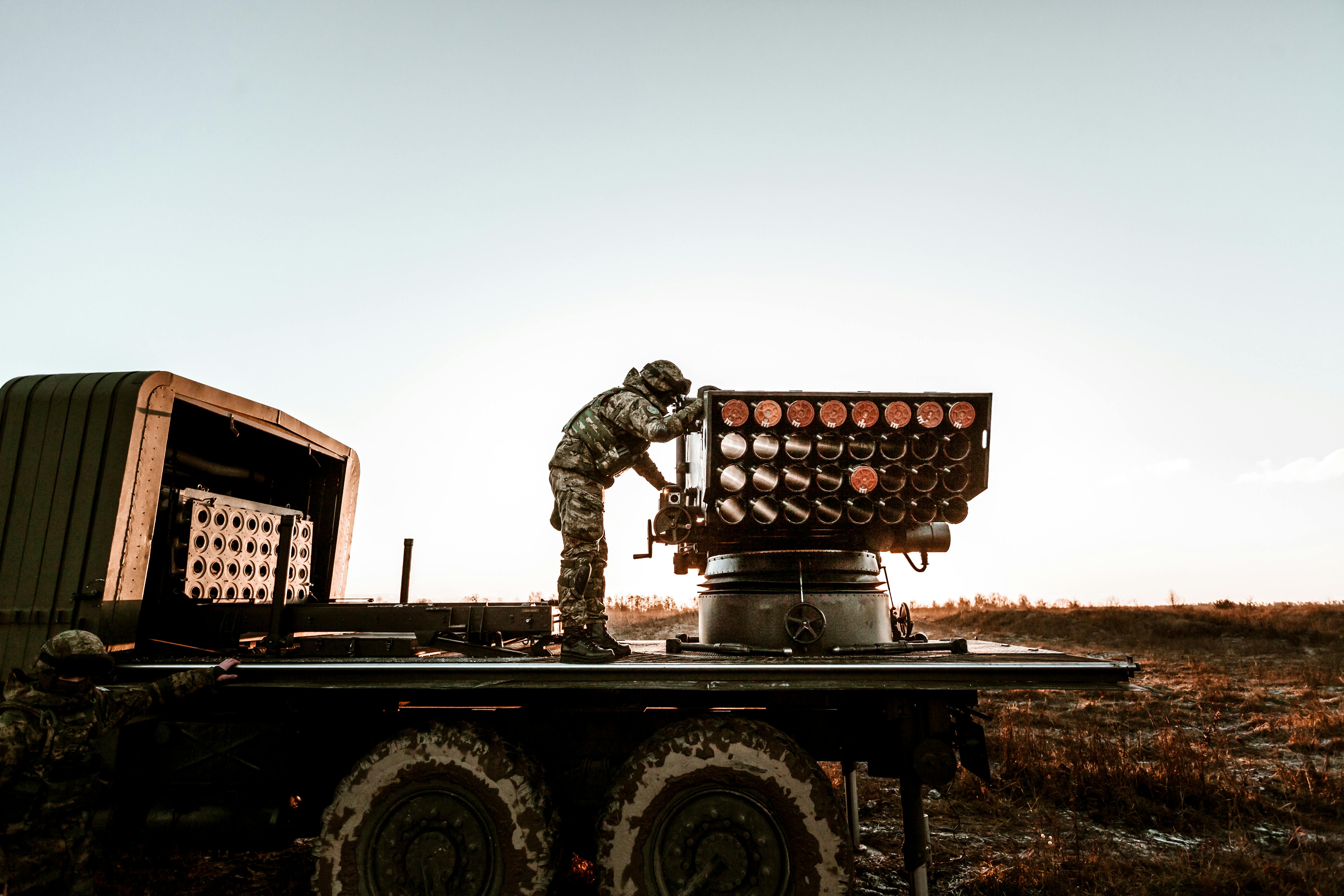
Russia's combat deployment of the Oreshnik hypersonic ballistic missile against Ukraine's Lviv region in January 2026, just 60 kilometres from the Polish border, represents the most direct hypersonic challenge to NATO's eastern flank to date. Combined with Beijing's September 2025 hypersonic ICBM test and Russia's forward deployment of Oreshnik to Belarus in December 2025, NATO now confronts an operational hypersonic threat, not a theoretical one. This brief makes three arguments.
First, the strategic disruption from hypersonic weapons should not rest primarily on claims of unprecedented speed. Analysts including Kunertova (2021) have rightly cautioned against overstating the novelty of hypersonic systems relative to existing ballistic threats. The genuine doctrinal challenge lies in the combination of trajectory unpredictability, a persistent sensor coverage gap in the 20-to-60-kilometre altitude band, and dual-use payload ambiguity that together degrade the quality of information available to decision-makers within an already compressed window.
Second, NATO's response deficit is technological, industrial, and most fundamentally political. The political will to sign multi-year procurement contracts at volumes sufficient for sustained attrition scenarios has not matched the rhetoric of urgency. The industrial base can respond; the procurement authorisations have not been given.
Third, the doctrinal priority is not replacing NATO's consensus-based political processes with delegated military authority. SACEUR already holds pre-delegated standing orders for immediate threats. The priority is updating those orders to reflect the specific intercept conditions, sensor trigger thresholds, and escalation parameters that manoeuvring hypersonic glide vehicles present, parameters for which existing frameworks were not designed.
Introduction: The Oreshnik Moment
On 9 January 2026, Russia launched the Oreshnik hypersonic ballistic missile for only the second time in combat, targeting critical infrastructure in Ukraine's Lviv region, some 60 kilometres from the Polish border, a NATO member state. European leaders condemned the strike as 'escalatory and unacceptable' (Al Jazeera, 2026), and Ukrainian Foreign Minister Andrii Sybiha called it 'a grave threat to the security on the European continent and a test for the transatlantic community' (CBS News, 2026). Russian state media claimed the weapon could reach a Polish air base in eleven minutes and NATO headquarters in Brussels in seventeen (Euronews, 2026). Kremlin spokesman Dmitry Peskov characterised the Lviv strike as a deliberate capability demonstration directed at Western supporters of Ukraine, while Russian state television host Dmitry Kiselyov broadcast countdown timers to named European capitals. These communications were not incidental. Russia has systematically exploited the Oreshnik's dual-capable character as a coercive instrument, using its payload ambiguity as psychological leverage rather than allowing it to remain a passive technical feature. The weapon's ambiguity is itself the message.
The Oreshnik strike did not occur in isolation. In August 2025, President Vladimir Putin ordered its mass production (The Defense Watch, 2025). On 30 December 2025, Russia forward deployed the system to Belarus, materially closing flight times to European capitals (Al Jazeera, 2026). In late September 2025, China conducted a hypersonic ICBM test employing boost-glide technology and a depressed trajectory designed to reduce detection windows and complicate interception (The Defense Watch, 2025). Turkey's Roketsan announced in late 2025 that mass production of its Tayfun Block-4 hypersonic ballistic missile would commence in 2026, adding a further dimension to an already complex proliferation landscape (Newsweek, 2025). These are not future contingencies. They are present realities.
This brief examines how hypersonic weapons challenge NATO's deterrence architecture, assesses the alliance's current response, and advances targeted policy recommendations for the post-Oreshnik strategic environment. It is written for an audience of emerging North Atlantic policy professionals who understand that credible deterrence must be earned and that the time to act is now.
The Strategic Disruption: What Hypersonic Weapons Change
Speed, Novelty, and the Case for Analytical Precision
Before examining what hypersonic weapons genuinely change, it is important to address the sceptical case directly. Dominika Kunertova of ETH Zurich's Centre for Security Studies has argued persuasively that hypersonic weapons are both weaponised and overhyped: the speed advantages of hypersonic glide vehicles (HGVs) over advanced ballistic missiles are often incremental rather than categorical, and the framing of 'revolutionary' threats has historically served institutional and procurement interests as much as operational ones (Kunertova, 2021). This brief accepts that premise in part. Speed alone does not rewrite the deterrence calculus. A system travelling at Mach 10 instead of Mach 7 does not create a qualitatively new strategic paradigm if the sensor architecture, intercept geometry, and response framework remain unchanged.
But three factors in combination produce doctrinal challenges that existing frameworks have not adequately addressed, and they must be analysed as a composite rather than separately.
Trajectory variability
Unlike ballistic missiles, whose flight paths follow predictable Keplerian arcs calculable from radar data gathered in the boost phase, HGVs manoeuvre unpredictably throughout their flight envelope. This is not a marginal speed difference; it is a qualitatively different intercept geometry problem. A PAC-3 fire-control solution can be computed against a ballistic trajectory from data gathered in the first sixty seconds of flight. Against a manoeuvring HGV, that solution must be continuously recomputed against a target actively defeating it, regardless of the absolute time available.
The sensor coverage gap
HGVs operate at altitudes of 20 to 60 kilometres, below the detection cone of space-based infrared sensors optimised for the heat signatures of ballistic missile ascent phases, and above the radar sweep of most ground-based terminal air defences (Joint Air Power Competence Centre, 2022). The NATO Science and Technology Organisation’s 2024 research symposium in Koblenz confirmed that existing air defence radars retain sufficient performance to cue intercept solutions against hypersonic threats, but only when reliable satellite cueing is available: a capability the alliance currently lacks (NATO STO, 2025). The gap is structural, not incidental, and cannot be closed by producing more of the same interceptors.
Dual-use ambiguity combined with degraded information quality
NATO and the United States’ nuclear command and control (C2) has long operated under compressed timelines. US nuclear threat planning already accounts for submarine-launched ballistic missile (SLBM) scenarios with warning windows of ten to fifteen minutes. Those protocols rest on a critical assumption: that a detected launch is classifiable and a trajectory is assessable within the first minutes of flight. A manoeuvring HGV that enters the sensor coverage gap, offers no stable trajectory solution, and carries an uncharacterisable payload presents decision-makers with qualitatively poorer information within a similarly compressed window. The doctrinal problem is not simply that there is less time; it is that the information available within that time is less actionable. This combination, not speed alone, is what genuinely distinguishes hypersonic glide vehicles and justifies targeted doctrinal revision.
Compression of Decision Time: Political Consensus and Military C2
A critical analytical distinction is required before addressing decision-making under hypersonic threat conditions. NATO's political decision-making operates by consensus: North Atlantic Council decisions on Article 5 invocation, force posture commitments, and strategic concept adoption require unanimity among thirty-two member states. NATO's military command and control do not. Under the authority of Supreme Allied Commander Europe (SACEUR), standing rules of engagement and pre-delegated response authorities govern immediate military responses to threats in real time, without NAC consensus. If Oreshnik were launched against NATO territory, the initial response would be governed by SACEUR's standing orders, not by an emergency plenary in Brussels. As the editor's note on this passage correctly observes, in a bolt-from-the-blue scenario the operational response rests entirely on SACEUR's interpretation of standing orders and the capabilities available on the ground.
What HGVs challenge is the adequacy of those standing orders for a new threat class. Existing response authorities were calibrated against a ballistic missile threat model with established intercept geometry and radar coverage assumptions that no longer fully apply. The doctrinal gap is not an absence of pre-delegated authority; it is that the sensor trigger conditions, intercept thresholds, and escalation management protocols embedded in those orders have not been updated to reflect the detection gaps and payload ambiguity specific to manoeuvring hypersonic threats. Updating SACEUR's standing orders and gaming out hypersonic-specific scenarios within existing pre-authorised response frameworks is therefore the operationally urgent priority. This is a military planning revision, not a political one, and it does not require NAC consensus to accomplish.
Erosion of Deterrence by Denial: The Tripartite Deficit
NATO's Integrated Air and Missile Defence (IAMD) Policy, endorsed at the February 2025 Defence Ministerial, formally commits the alliance to layered defences against all velocities and altitudes, including hypersonic (NATO, 2025). The gap between that commitment and operational reality has three components: a sensor architecture deficit, an interceptor production shortfall, and a deficit of political will that is the master variable behind both.
On sensor architecture, the 20-to-60-kilometre altitude band is structurally under-covered by existing early warning systems. Three European Defence Fund projects are relevant: EU HYDEF, addressing an advanced interceptor; HYDIS, addressing the sensor-intercept system architecture; and ODIN'S EYE, addressing early-warning satellite capability. All remain at the development or concept study stage (NATO STO, 2025). Increased funding advances concept validation and technical readiness levels; it does not produce operational systems on a compressed timeline when design maturity has not yet been established. The argument that funding HYDIS at a higher rate will bring forward delivery timelines must be applied with care: if a programme is still at concept study, the constraint is technical readiness, not procurement speed.
On interceptor production, the United States currently produces approximately 550 PAC-3 Missile Segment Enhancement rounds per year. Ukraine's conflict experience has demonstrated that a single Kinzhal intercept typically requires multiple interceptors per engagement. At those ratios, sustained Oreshnik salvos against NATO's eastern flank would rapidly deplete forward-deployed stockpiles without a politically authorised production expansion. The Glide Phase Interceptor (GPI), in competitive development between Northrop Grumman and L3Harris following a US Missile Defense Agency funding commitment in 2021, addresses the manoeuvring HGV interception problem that existing interceptors were not designed to solve. Additional GPI funding can accelerate competitive design choices and testing cycles. It cannot, however, produce an operationally deployable system before the early 2030s if the technical baseline is not yet established.
On political will, which is the primary bottleneck: member states have the industrial base to expand PAC-3, SM-6, and Aster-30 production substantially within a two-to-three-year window if governments commit to multi-year procurement contracts at the necessary volumes. The constraint is not factory capacity or workforce availability in the first instance; it is the political decision to sign those contracts and authorise the expenditure at scale. The RealClearDefense formulation that 'NATO's defences are not keeping pace because procurement timelines are too slow' (RealClearDefense, 2025) conflates a symptom with its cause. Procurement timelines are slow because political commitment to fund multi-year contracts at scale has been absent. The question is not whether industry can respond; it demonstrably can. The question is whether governments will authorise the expenditure.
Dual-Use Ambiguity and Escalation Risk: The Rhetoric Dimension
The Oreshnik was reportedly equipped with conventional warheads during its January 2026 strike, yet the system is nuclear-capable (Al Jazeera, 2026). Russia has not merely allowed this ambiguity to exist; it has actively weaponised it as a coercive instrument. Kremlin spokesman Dmitry Peskov's framing of the Lviv strike as a deliberate capability signal, Russian state television's broadcast of countdown timers to European capitals, and Putin's immediate ordering of mass production following the strike constitute a systematic escalatory communication strategy. The weapon's dual-use character is the message: Russia deploys the nuclear capability visibly while leaving the payload of any given strike uncertain, exploiting that uncertainty as a lever against alliance cohesion and public confidence in deterrence.
This reinforces the case for a dedicated NATO response framework that addresses the signalling environment, not only the physical intercept problem. As the Joint Air Power Competence Centre (2022) has argued, the integration of hypersonic weapons into Russian operational doctrine alongside explicit nuclear threat rhetoric creates escalatory dynamics qualitatively distinct from those associated with conventional ballistic missiles. A robust, publicly communicated commitment to pre-authorised interception, analogous to declared air-defence rights over NATO territory, would reduce Russia's ability to exploit hypersonic ambiguity as psychological leverage without requiring prior resolution of the intercept geometry problem.
The Iran Theatre: Hypersonic Proliferation in Practice
The threat horizon for NATO expanded dramatically on 28 February 2026 when the United States and Israel launched coordinated strikes against Iran, Operation Epic Fury and Operation Roaring Lion, respectively, targeting its nuclear programme, ballistic missile infrastructure, and military leadership (House of Commons Library, 2026). Iran retaliated with waves of ballistic missiles and drones against Israeli cities, US military bases in Bahrain, Jordan, Kuwait, and Qatar, and Gulf state energy infrastructure (Al Jazeera, 2026b). Of particular significance to NATO planners was Iran's deployment of the Fattah-1 hypersonic ballistic missile, which travels at terminal speeds of Mach 13 to Mach 15, has a range of 1,400 kilometres, and features a manoeuvrable glide vehicle capable of altering trajectory in multiple axes to penetrate layered missile defences (Army Technology, 2026). Iran claimed the Fattah represented the 'beginning of the end' of Israel's missile defence network (Military Watch Magazine, 2025).
The proliferation dimension is what most directly concerns NATO planners. Iran's rapid acquisition of Mach 5-plus missile technology raises pointed questions about external technical assistance. Iran switched its missile guidance architecture from GPS to China's BeiDou-3 navigation system, materially improving accuracy (Militarnyi, 2026). Reports indicate Iran acquired Chinese HQ-9B long-range surface-to-air systems in 2025 and early 2026, with negotiations under way for the potential purchase of China's DF-17 hypersonic glide vehicle (19FortyFive, 2026). A Defence Security Monitor assessment confirmed that Iran turned to both Moscow and Beijing to replenish and upgrade its missile arsenal following attrition in the June 2025 Twelve-Day War (Defence Security Monitor, 2026). Analysts have also noted that North Korean transfers of hypersonic glide vehicle technology may have provided indirect technological pathways to Tehran (Military Watch Magazine, 2025).
The strategic implications for NATO are threefold. First, the Iran conflict demonstrates that hypersonic-class weapons are no longer the exclusive preserve of the great powers. A mid-tier regional state has fielded and operationally deployed missiles flying above Mach 5 against multilayered defences that include Arrow, THAAD, Patriot, and David's Sling, the same architecture upon which NATO's eastern flank partially depends. Second, the Iran case reveals the inadequacy of existing non-proliferation frameworks: unlike nuclear weapons, hypersonic delivery systems are not subject to any dedicated treaty regime, and dual-use components move across borders with limited interdiction. Third, the Russia-China-Iran technology nexus signals an emerging counter-NATO alignment in which advanced missile capabilities are deliberately transferred to erode the deterrence architecture of the United States and its allies. The Iran theatre is not a peripheral regional conflict; it is a live demonstration of hypersonic proliferation at an operational scale.
NATO's Current Response: Necessary but Insufficient
NATO has not been passive. The alliance formally incorporated hypersonic systems into its Emerging and Disruptive Technology Implementation Roadmap in December 2019 (NATO, n.d.). The June 2025 Hague Summit endorsed a Rapid Adoption Action Plan to compress technology integration timelines to a maximum of twenty-four months (NATO, n.d.). Individual member states have accelerated investment: Germany's Sky Shield initiative, NATO joint Patriot procurement, and the UK-Germany Deep Precision Strike programme, announced in March 2026, which aims to develop a family of stealth cruise and hypersonic weapons with ranges exceeding 2,000 kilometres, targeting service entry in the 2030s (Army Recognition, 2026).
These are meaningful steps, but they do not yet constitute a coherent or adequately paced strategic response. Three structural deficiencies stand out.
First, a critical distinction must be drawn between capability timelines that reflect industrial procurement constraints and those that reflect a deficit of political will. These are not the same problem, and they do not respond to the same solutions. Where programmes are in development but underfunded, politically sustained commitment can materially accelerate delivery. Where programmes remain at the concept study stage, the constraint is technical readiness level rather than funding, and increased investment advances design maturity rather than production timelines. Conflating the two produces misleading assessments of what urgency can achieve.
Second, alliance coordination on hypersonic strategy remains fragmented. Member states pursue national programmes with limited interoperability planning, producing duplication and coverage gaps that a coherent alliance framework could address.
Third, doctrine has not kept pace with the specific technical challenges HGVs present. The gap is not an absence of pre-delegated response authority; SACEUR's standing orders already provide for immediate military responses to threats without NAC consensus. The gap is that the sensor trigger conditions, intercept thresholds, and escalation management protocols embedded in those orders have not been updated to reflect the detection gap and payload uncertainty specific to manoeuvring hypersonic threats.
Ukraine's conflict experience provides a partial corrective: Ukrainian Patriot batteries successfully intercepted Kinzhal missiles, demonstrating that existing interceptors retain real utility against hypersonic threats. The lesson is that the political and procurement decisions to field adequate quantities of proven interceptors forward must match the urgency of the threat. They have not yet done so.
Policy Recommendations
Establish a NATO Hypersonic Deterrence Framework
NATO should codify hypersonic weapons as a distinct strategic category within its deterrence doctrine, grounded in the specific technical characteristics that distinguish manoeuvring HGVs from ballistic missiles: trajectory unpredictability, the 20-to-60-kilometre sensor coverage gap, and dual-use payload ambiguity. A dedicated hypersonic annex to NATO's Strategic Concept should define intercept trigger thresholds, escalation management protocols, and the conditions under which pre-delegated SACEUR response authority applies to hypersonic attack scenarios. The Ukraine-NATO Council emergency convened after the January 2026 Oreshnik strike (CBS News, 2026) should be institutionalised as a standing hypersonic crisis consultation mechanism.
Adopt a Tiered Investment Strategy Calibrated to Programme Maturity
NATO should distinguish investment priorities by programme maturity rather than treating all hypersonic defence programmes as requiring the same intervention. For proven interceptors (PAC-3 MSE, SM-6, Aster-30), the priority is politically authorised multi-year procurement contracts at volumes sufficient for sustained attrition scenarios: this requires political decisions, not industrial solutions. For GPI, the priority is funding stability and competition protection to sustain the development process through to early-2030s deployment. For HYDIS and EU HYDEF, the priority is concept validation funding and structured international design cooperation that advances technical readiness levels without overstating near-term deliverability.
Advocacy that conflates production acceleration of proven systems with concept acceleration of developmental programmes risks misallocating resources and overpromising to alliance publics. The UK's commitment of over £400 million to hypersonic and long-range weapons in the current financial year (Army Recognition, 2026) provides a model of politically authorised sustained investment; the challenge is extending it across the alliance at the required volumes.
Deploy a Layered Space-Based Sensor Architecture
Existing early warning infrastructure, optimised for ballistic trajectories, leaves the HGV altitude band structurally under-covered. NATO should prioritise deployment of space-based infrared sensor networks capable of tracking manoeuvring targets in the 20-to-60-kilometre band, integrate the US Space Development Agency's Tracking Layer satellites into alliance-wide data-sharing protocols, and invest in AI-enabled data fusion for real-time cueing of ground and sea-based interceptors. The NATO STO's 2024 research symposium found that existing air defence radars retain adequate performance to support effective intercept solutions, but only when reliable satellite cueing is available (NATO STO, 2025). The space-based sensor layer is therefore the enabling prerequisite for making expanded interceptor stockpiles operationally effective, not a supplementary investment.
Update SACEUR's Pre-Authorised Response Framework for Hypersonic Scenarios
NATO's political decision-making is consensus-based; its military command and control is not. SACEUR's standing orders already provide pre-delegated authority to respond to immediate threats without requiring NAC votes. The doctrinal task is to update those standing orders to reflect the specific intercept geometry and payload ambiguity of manoeuvring hypersonic threats. This requires targeted revision of sensor trigger conditions, intercept thresholds, and escalation management parameters; enhanced crisis simulation exercises that specifically game out pre-delegated authority under hypersonic attack scenarios; and clearly defined conditions for pre-authorised interceptor launch below the threshold of retaliatory action.
NATO has navigated compressed-timeline pre-authorisation challenges before. The graduated alert postures developed under flexible response doctrine and the pre-delegation frameworks of the Nuclear Planning Group demonstrate that such frameworks can be constructed with appropriate democratic oversight and political accountability. The task is to extend and update that architecture specifically for the HGV threat environment that existing standing orders were not designed to address. Substantive reflection on how those earlier frameworks managed the tension between speed of military response and political accountability would enrich the current policy debate considerably.
Pursue Forward-Looking Arms Control Dialogue
Deterrence and arms control are not mutually exclusive. NATO should engage Russia and China in structured dialogue on hypersonic weapons risk reduction, including transparency measures on deployment locations and operational doctrines. The forward deployment of Oreshnik to Belarus, which materially reduces strike timelines against NATO capitals, could serve as a test case for confidence-building notifications. The International Centre for Defence and Security (2025) has noted that NATO's own pursuit of hypersonic capabilities could provide leverage in such negotiations; the UK-Germany Deep Precision Strike programme, framed as a conventional deterrent, reinforces this logic.
Arms control dialogue must also address the proliferation problem exposed by the Iran conflict. The transfer of BeiDou guidance integration, HQ-9B air defence components, and suspected HGV technology from China and Russia to Iran (19FortyFive, 2026; Defence Security Monitor, 2026) represents a deliberate strategy to erode Western deterrence through third-party capability distribution. NATO should pursue, within the Wassenaar Arrangement and through bilateral pressure on Beijing, binding controls on the export of dual-use hypersonic materials and guidance systems, treating such transfers as equivalent in severity to nuclear technology proliferation.
Conclusion
The Oreshnik strike of January 2026, and Moscow's deliberate amplification of its coercive implications through escalatory rhetoric, confirmed that hypersonic weapons are operational, dual-capable, and deployed within striking distance of NATO territory. The argument for a revised NATO response does not rest on claims that hypersonic represent a wholly unprecedented strategic paradigm. Analysts who note the continuity with earlier compressed-timeline threats are right that speed alone does not rewrite deterrence logic, and the alliance should resist the temptation to invoke hypersonic novelty as a justification for unfocused expenditure.
The genuine case for reform is more specific and more tractable. It rests on three problems that are neither rhetorical nor hypothetical: a structural sensor coverage gap that existing early warning architecture was not designed to close; pre-authorised response frameworks calibrated against a ballistic missile threat model that manoeuvring HGVs have rendered partially obsolete; and a political commitment to interceptor production that has consistently fallen short of the volumes required for sustained attrition scenarios. None of these requires a paradigm shift in deterrence theory. Each requires a combination of technically grounded sensor investment, politically sustained procurement commitments at scale, and targeted revision of SACEUR's standing orders that preserves democratic accountability while closing the specific gaps that the post-Oreshnik environment has exposed.
For emerging North Atlantic policy professionals, the challenge is to avoid two failure modes simultaneously: the breathless novelty claim that hypersonic change everything and justify any expenditure, and the complacent continuity argument that existing doctrine suffices. The technically grounded middle ground is where credible policy lives. The credibility of the North Atlantic bond depends on whether NATO can occupy that ground before its adversaries conclude that it cannot.
References
Al Jazeera. (2026, January 10). Russia hits Ukraine with Oreshnik hypersonic missile: Why it matters. https://www.aljazeera.com/news/2026/1/10/russia-hits-ukraine-with-oreshnik-hypersonic-missile-why-it-matters
Al Jazeera. (2026b). Iran retaliates against US and Israeli strikes on Iranian territory. https://www.aljazeera.com
Army Recognition. (2026, March). UK and Germany to launch 2,000 km cruise hypersonic deep strike missiles for NATO deterrence. https://www.armyrecognition.com/news/aerospace-news/2026/uk-and-germany-to-launch-2-000-km-cruise-hypersonic-deep-strike-missiles-for-nato-deterrence
Army Technology. (2026). Fattah-1 hypersonic ballistic missile, Iran. https://www.army-technology.com/projects/fattah-hypersonic-ballistic-missile-iran/
CBS News. (2026, January 9). Russia says it used new Oreshnik hypersonic missile in massive strike on Ukraine. https://www.cbsnews.com/news/russia-ukraine-war-hypersonic-missile-oreshnik-massive-strike
Defence Security Monitor. (2026, February 27). Iran turned to Russia, China for missiles after 12-day war. https://dsm.forecastinternational.com/2026/02/27/iran-turned-to-russia-china-for-missiles-after-12-day-war/
Euronews. (2026, January 9). UK, Germany and France call Russia's Oreshnik attack on Ukraine 'unacceptable'. https://www.euronews.com/2026/01/09/uk-germany-and-france-call-russias-oreshnik-attack-on-ukraine-unacceptable
House of Commons Library. (2026). US/Israel-Iran conflict 2026. https://commonslibrary.parliament.uk/research-briefings/cbp-10521/
International Centre for Defence and Security. (2025, November 5). NATO's hypersonic challenge. https://icds.ee/en/natos-hypersonic-challenge
Joint Air Power Competence Centre. (2022, April 28). Hypersonics: Changing the NATO deterrence game. https://www.japcc.org/essays/hypersonics-changing-the-nato-deterrence-game
Kunertova, D. (2021). Weaponized and overhyped: Hypersonic technology. CSS Analyses in Security Policy, No. 285. Centre for Security Studies, ETH Zurich. https://css.ethz.ch/content/dam/ethz/special-interest/gess/cis/center-for-securities-studies/pdfs/CSSAnalyse285-EN.pdf
Militarnyi. (2026). Iran's ballistic missiles: Weapons of terror that have failed to deliver. https://militarnyi.com/en/articles/iran-ballistic-missiles-terror-failed/
Military Watch Magazine. (2025, June 18). Iran launches first strike on Israel using Mach 13+ Fattah hypersonic missile: Can it turn the tide of the war? https://militarywatchmagazine.com/article/iran-launches-first-strike-isreal-mach-13-fattah-hypersonic
NATO. (2025, February 13). NATO integrated air and missile defence policy. https://www.nato.int/cps/en/natohq/official_texts_233084.htm
NATO. (n.d.). Emerging and disruptive technologies. https://www.nato.int/en/what-we-do/deterrence-and-defence/emerging-and-disruptive-technologies
NATO Science and Technology Organization. (2025). Territorial defence against hypersonic missiles. STO-MP-AVT-SET-SCI-396. https://www.sto.nato.int/document/territorial-defence-against-hypersonic-missiles/
Newsweek. (2025, September 1). NATO ally releases update on new hypersonic weapon. https://www.newsweek.com/nato-ally-releases-update-new-hypersonic-weapon-2122631
PBS News. (2026, January 9). Russia uses its new hypersonic missile in major attack on Ukraine and warning to the West. https://www.pbs.org/newshour/world/russia-uses-its-new-hypersonic-missile-in-major-attack-on-ukraine-and-warning-to-the-west
RealClearDefense. (2025, October 1). NATO's hypersonic defense problem is industrial, not technological. https://www.realcleardefense.com/articles/2025/10/01/natos_hypersonic_defense_problem_is_industrial_not_technological_1138155.html
The Defense Watch. (2025, October 6). Hypersonic weapons race 2026: U.S., Russia, China vie for supremacy in speed and strike. https://thedefensewatch.com/military-ordnance/hypersonic-weapons-race-u-s-russia-china
19FortyFive. (2026, March). China could sell to Iran aircraft carrier killer missiles, air defense and hypersonic weapons when war is over. https://www.19fortyfive.com/2026/03/china-could-sell-to-iran-aircraft-carrier-killer-missiles-air-defense-and-hypersonic-weapons-when-war-is-over/
Dr. Tahir Mahmood Azad is currently a research scholar at the Department of Politics & International Relations, the University of Reading, UK. He previously served as an Affiliate Researcher at King’s College London and held fellowships at Sandia National Laboratories (USA), the University of Bristol, the University of Georgia (USA), the Graduate Institute Geneva, ISDP Stockholm, and PRIF Germany. He completed a postdoctoral fellowship at the University of Leicester and holds a PhD in Strategic & Nuclear Studies from National Defence University (NDU), Pakistan. Azad also worked as a Research Fellow and Programme Coordinator at the Institute of Strategic Studies Islamabad (ISSI), Pakistan. His research focuses on nuclear politics, missile proliferation, China’s military modernisation, politics & security in the Indo-Pacific and Middle East regions, and South Asian strategic affairs.
LinkedIn: www.linkedin.com/in/dr-tahir-mahmood-azad-b701479a/
E-mail: t.m.azad@pgr.reading.ac.uk
ORCID: 0000-0003-3826-2009