
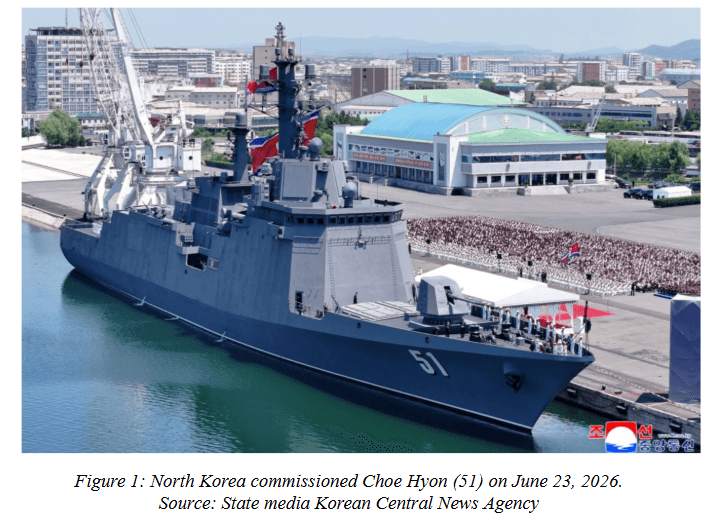
North Korea’s 조선인민군 해군 (Joseon Inmingun Haegun; Korean People’s Army Navy [KPAN]) is undergoing its most consequential transformation since the Korean War. In 2026, Kim Jong Un commissioned the 최현 (Choe Hyon: named after a Korean independence fighter), the nation's first 5000 ton guided missile destroyer, and further announced plans to build two warships of even greater class annually through 2030, and publicly declared that “Building a modernized naval base has emerged as a desperate and essential task.”
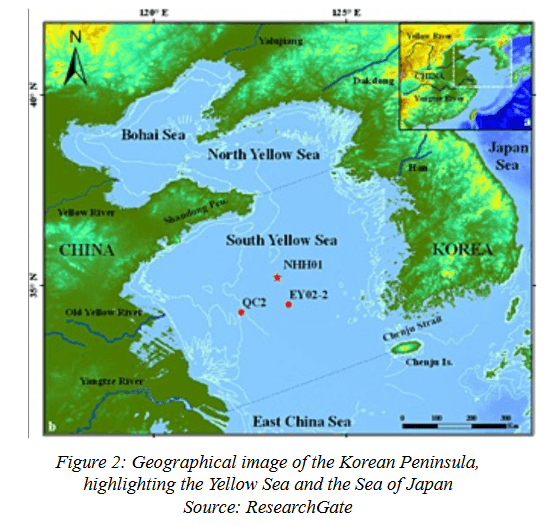
Contrary to popular opinion, this is not just a bilateral Korean problem. A nuclear-capable 근해 해군 (geunhae haegun; green-water navy) operating in the 동해 (Donghae; East Sea, also known internationally as the Sea of Japan) and the 서해 (Sohae; Yellow Sea, also called the West Sea) strategically reshapes the deterrence calculation for Japan, South Korea, and the broader Indo-Pacific. Yet the multilateral governance structure that surrounds this threat remains critically unaddressed and fragmented. Looking critically at Japan and South Korea, the two states most immediately exposed are developing deeper bilateral cooperation at an unprecedented pace However, structural problems accompany this progress, rooted in unresolved historical grievances as well as asymmetric threat perceptions, which creates further issues compared to what could be achieved independently.
This brief argues that a durable response to North Korea’s naval nuclear expansion requires a formalized and institutionally anchored Japan-South Korea defence framework, separating it from the bilateral political volatility, and establishing a multilateral maritime governance architecture that does not have to rely on other leaderships to function.
Analysis of the current policy
North Korea’s Naval Transformation: The Threat in Detail
Kim Jong Un and his 국방 5개년 계획 (Gukbang O-gaenyeon Gyehoek; Five-Year National Defence Plan, 2026–2030) represent what can be classified as a shift from a coastal navy (연안 해군; yeonan haegun; brown-water) to a regionally protecting navy 근해 해군 (geunhae haegun; green-water navy). The KPAN is on track to field up to an estimated 12 Choe Hyon-class destroyers in 2030 (around 2 made every year for the next 5 years), supported by a satellite image from Nampo and Chongjin shipyards (Bermudez Jr. et al. 2025), which indicates the construction of the third and likely fourth vessels is already underway. Kim also further announced his ambitions of having a 10,000-ton class ‘strategic warship’(Oh 2026), which, by estimate, would double the displacement of the Choe Hyon and would represent a qualitative leap in blue-water projection capability.
The distinction in this naval build-up from the normal conventional force modernization is the explicit nuclear capability. The Choe Hyon has been publicly demonstrated firing cruise missiles, which South Korean analysts describe as a domestic variant of the Russian Kh-35 anti-ship missile, and its 수직발사체계 (sujik balsa chaegye; vertical launch system [VLS]) cells are designed primarily for nuclear-capable land-attack cruise missiles. North Korea further formally enshrined a pre-emptive nuclear strike doctrine called 핵방아쇠 (Haekpangasoe, which literally translates to "nuclear trigger"), and it is an integrated nuclear crisis response system. IMO (International Maritime Organization) registration of the Choe Hyon in April 2026 made it the first North Korean surface combatant in the global shipping registry and signals Pyongyang’s intent to operate in international waters. (Choe 2026; Davenport 2026).
Russia has played a key role in this transformation, as North Korean troops that were deployed in Ukraine have returned with modern warfare expertise in three areas: operations, electronic warfare, and logistics (Iimura 2026). It has been widely agreed upon, through a detailed assessment with security analysts, that Russia supplied technology, materials, and design assistance for North Korea’s shipbuilding, with evidence being present of Russian-origin systems in the Choe Hyon weapon suite (ISW-CDOT 2026). A five-year Russia-DPRK military cooperation is currently being finalized and further indicates that the relationship is institutionally deepening and not just merely transactional (Jang 2026).
The Japan-South Korea Cooperation Ceiling
Japan and South Korea have made measurable progress in defence cooperation as both nations' defence ministers have agreed to upgrade bilateral cooperation in January 2026, with trilateral naval chiefs meeting in Seoul in April to discuss counter-KPAN strategies, and the two navies resumed their bilateral SAREX (Search and Rescue Exercise) after a nine-year suspension (Reuters 2026). This demonstrates meaningful steps and reflects a pragmatic recognition from both Seoul and Tokyo that shared security imperatives now outweigh political friction.
However, the cooperation ceiling remains structurally low. Taking the case of SAREX, it does not extend to joint combat operations, intelligence sharing on sensitive platforms, or even integrated command structures. The 한일군사정보보호협정 (Han-Il Gunsajeongbo Boho Hyeobjjeong, also known as the General Security of Military Information Agreement, GSOMIA: literally "Korea-Japan Military Intelligence Protection Agreement"), which is the intelligence sharing pact between the two countries, was nearly cancelled in 2019, and to this day continues to operate on a provisional basis, demonstrating how vulnerable it is to bilateral political deterioration. Historically, disputes over wartime labour (강제징용; gangjejing-yong, forced mobilisation), the status of 위안부 (wianbu; comfort women), and competing claims over 독도/다케시마 (Dokdo/Takeshima) islets have repeatedly derailed defence cooperation during periods of change in political leadership in Seoul (Kosuke 2026; Choi 2024).
Fundamentally, the major vulnerability of the current framework is in its informality: bilateral defence agreements between Japan and South Korea have no institutional anchor. The reason is that they exist as a set of bilateral agreements, depending on the political goodwill and subject to suspension whenever historical tensions flare up, which analysts call the 역사 갈등 (yeoksa galdeung; historical grievance) problem. Furthermore, there lacks any permanent secretariat, treaty obligation, or crisis management mechanism that functions independently regardless of the current government postures from both nations (Reuters 2026).
The Multilateral Governance Vacuum
Beyond the bilateral dimension, Northeast Asian maritime security governance is conspicuously thin as the region lacks any standing multilateral security institution comparable to NATO, the OSCE or even ASEAN’s imperfect mechanisms (Davenport 2026). The existing architecture i.e. the 한미동맹 (Han-Mi Dongmaeng; ROK-US Alliance), the 미일동맹 (Mi-Il Dongmaeng; US-Japan Alliance), the now-lapsed 6자회담 (Yukja Hoedam; Six-Party Talks) framework, and ad hoc trilateral coordination among Washington, Seoul, and Tokyo are almost entirely centered around the United States, which creates a critical single point of dependency, as it has previously demonstrated that if the US attention shift, the entire architecture loses its framework (Iimura 2026).
The KPAN’s nuclear-capable destroyers are operating in international waters, thereby raising specific questions that no existing institutions are equipped to answer. The major question that arises is: at what point does a nuclear-armed surface combatant transiting the 북방한계선 (Bukbang Hangye Seon; Northern Limit Line [NLL]) adjacent waters of international sea lanes trigger a response under international law? Even if that is taken into consideration, what rules of engagement govern intercept or operations in the 동해 (Donghae; East Sea)? How do Japan and South Korea coordinate real-time responses to KPAN provocation without the existence of a fully functioning integrated command? The existing answer to all of them is through informal bilateral relations or with US-mediated coordination, neither of which are institutionally grounded or incredibly robust.
Policy Recommendations
Establish a Permanent Japan-South Korea Maritime Security Secretariat
The two governments should create a standing bilateral secretariat (and can be modelled loosely on the Franco-German Defence and Security Council) (Élysée 2025) , specifically with a focus on maritime security in the 동해 (Donghae; East Sea) and 서해 (Sohae; Yellow Sea). However, this body should be constituted as a treaty and not as an executive agreement, as it allows room for change with different governments coming to power in both Seoul and Tokyo.
Its core functions should include:
Coordinating 해양영역인식 (haeyangnyeongnyeok insik; maritime domain awareness) data in real time
Managing GSOMIA on a permanent rather than provisional basis, and producing a joint annual threat assessment of KPAN capabilities
Embedding the secretariat with the existing Japan–South Korea framework of 역사적 화해 (yeoksajeok hwahae; historical reconciliation) processes, rather than treating security cooperation as entirely separate from historical dialogue, as both are interrelated
Formalize a Northeast Asia Maritime Incident Prevention Agreement (MIPA)
The three major players: Japan, South Korea, and North Korea, through either the UN or via ASEAN, should be invited to negotiate a Northeast Asia Maritime Incident Prevention Agreement governing naval vessels operating in the 황해 (Hwanghae; Yellow Sea), 동해 (Donghae; East Sea), and adjacent international waters.
Alongside this, China’s participation should be sought, given the PRC’s geographic position and its interest in stability in waters adjacent to its coast.
Furthermore, to ensure an equal playing field, this agreement would not require North Korea to give up its nuclear weapons and would narrowly focus on the engagement for naval encounters, communication protocols, and the notification of large-scale naval exercises.
There exists a precedent for this policy proposal: the 1972 US-Soviet INCSEA (Incidents at Sea Agreement) (US and USSR 1972) , where the management of naval risk was conducted without attempting to resolve underlying political conflict.
Extend GSOMIA to a Trilateral Intelligence Sharing Framework with a Permanent Mandate
The existing 한일군사정보보호협정 (GSOMIA) would be upgraded to a trilateral intelligence-sharing framework that includes, at the very least, real-time satellite and maritime surveillance for KPAN Deployments.
The reason for this is simple: currently, GSOMIA presents a critical risk, for if the agreement lapses right before a nuclear crisis, both Japan and South Korea would lose critical intelligence interoperability at the worst possible time for both nations.
As a result, this framework, accompanied by a permanent mandate, insulates it from bilateral political disputes, as noted earlier.
Pursue a UN Security Council Resolution defining naval nuclear deployments as a Proliferation concern
North Korea, as a state, has renounced the Nuclear Non-Proliferation Treaty (NPT) and does not participate in standard naval arms control frameworks. As a result, their deployment of nuclear-capable warships in international waters raises a genuine concern and a governance challenge.
Japan and South Korea should jointly sponsor a UN Security Council resolution regarding this matter. If vetoed, then a UN General Assembly resolution (under the Uniting for Peace procedures) that classifies the deployment of nuclear-capable surface combatants by non-NPT states as a threat to regional maritime security requiring multilateral monitoring.
What this creates is not a binding enforcement of obligations but rather a legal record, a framework for future UN maritime observer missions , and would also constrain North Korea's ability to use IMO as an instrument of legitimacy in order to present itself as a natural maritime state.
Build KPAN Threat Assessment into ASEAN’s Regional Security Dialogue architecture
North Korea and its maritime ambitions are not geographically confined to Northeast Asia. KPAN and its deployments in international waters affect other SEA countries. Japan and South Korea should advocate for the inclusion of the Korean Peninsula naval security as a standing agenda item in the ASEAN Regional Forum (ARF) as well as the ASEAN Defence Ministers’ Meeting Plus (ADMM+).
The reason is that it serves a dual purpose: it broadens the diplomatic response coalition beyond the US and engages China (which is an ASEAN dialogue partner) in a multilateral format where Beijing has a reputational stake in constructive engagement.
References
Bermudez Jr., Joseph S., Victor Cha and Jennifer Jun. 2025. "Nampo Guided Missile Frigate Unwrapped". Beyond Parallel, CSIS Korea Chair, April 23, 2025. https://beyondparallel.csis.org/nampo-guided-missile-frigate-unwrapped/
Choe, Sang-HunThe New York Times. 2026. "North Korea Deploys Its First Destroyer, Vowing to Project Nuclear Power by Sea." The New York Times, June 25, 2026. https://www.nytimes.com/2026/06/25/world/asia/north-korea-destroyer-nuclear.html
Choi, WooseonCenter for Strategic and International Studies. 2024. "New Horizons in Korea–U.S.–Japan Trilateral Cooperation." CSIS, June 27, 2024. https://www.csis.org/analysis/new-horizons-korea-us-japan-trilateral-cooperation
Davenport, Kelsey. 2026. "North Korea Seeks Nuclear Recognition for U.S. Talks." Arms Control Association, April 2026. https://www.armscontrol.org/act/2026-04/news/north-korea-seeks-nuclear-recognition-us-talks
Élysée. 2025. "Conclusions du Conseil franco-allemand de défense et de sécurité." Toulon: Présidence de la République, August 29, 2025. https://www.elysee.fr/emmanuel-macron/2025/09/02/conclusions-du-conseil-franco-allemand-de-defense-et-de-securite-1
Iimura, TomokiJapan Institute of International Affairs. 2026. "Chapter 4: The Korean Peninsula — The ROK and North Korea Seek Strategic Advantage." In Strategic Outlook 2026. Tokyo: Japan Institute of International Affairs (JIIA)IIA. https://www.jiia.or.jp/eng/upload/eng/StrategicOutlook2026_EN_web_04.pdf
Institute for the Study of War (ISW-CDOT). 2026. "Korean Peninsula Update, June 23, 2026." Institute for the Study of War, June 23, 2026. https://understandingwar.org/research/china-taiwan/korean-peninsula-update-june-23-2026/
Jang, Ye-ji. 2026. "North Korea and Russia Hail Ties 'Written in Blood,' Discuss Continued Military Cooperation." The Hankyoreh, April 28, 2026. https://english.hani.co.kr/arti/english_edition/e_northkorea/1256301.html
Kosuke, Takahashi. 2026. “What the Japan-South Korea SAREX Revival Really Means.” The Diplomat, June 8, 2026. https://thediplomat.com/2026/06/beyond-search-and-rescue-what-the-japan-south-korea-sarex-revival-really-means/
Oh, Seok-minYonhap News Agency. 2026. "Lee Visits Front-Line Marine Corps Unit, Stresses Strong Deterrence Against Enemy." Yonhap News Agency, June 24, 2026. https://en.yna.co.kr/view/AEN20260624001800315
Reuters. 2026. "South Korea, Japan Defence Ministers Agree to Upgrade Cooperation." January 30, 2026. https://www.reuters.com/world/asia-pacific/south-korea-japan-defence-ministers-agree-upgrade-cooperation-2026-01-30/
United States and Union of Soviet Socialist Republics. 1972. Agreement Between the Government of the United States of America and the Government of the Union of Soviet Socialist Republics on the Prevention of Incidents On and Over the High Seas. Signed in Moscow, May 25, 1972. U.S. Department of State Archives. https://2009-2017.state.gov/t/isn/4791.htm
Medhaansh Ghosh is an Indian national based in the Netherlands and is an undergraduate researcher in political science, public policy and economics at Lake Forest College, where he is graduating one year ahead of schedule. His research spans international security architecture, missile defence policy, critical infrastructure protection, nuclear non-proliferation, and Indo-Pacific geopolitics, with a particular focus on Northeast Asian maritime security, naval nuclear deterrence, EU governance gaps, and multilateral defence frameworks. He completed and defended a 124-page undergraduate thesis on the Kashmir conflict and has presented several original research papers at the Galovich Symposium for Academic Excellence. He is a member of the CFC Chatham House and is an independent policy and investigative researcher. He has studied across the Netherlands, the United States, and New Zealand, and is currently working on various papers regarding international security and defence policy.
Contact: https://www.linkedin.com/in/medhaansh-ghosh | medhaansh.ghosh@gmail.com