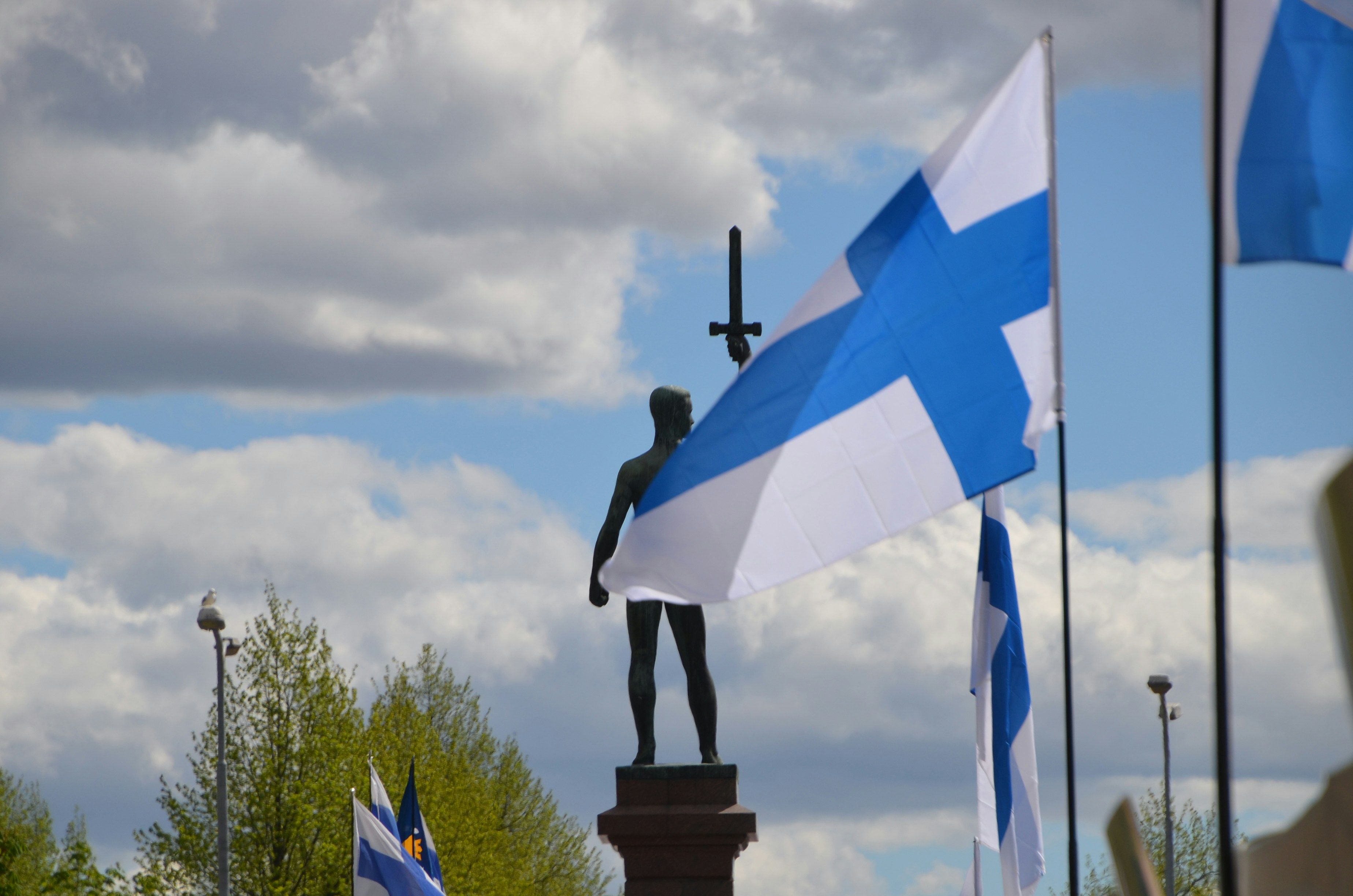
Finland became NATO's 31st member on 4 April 2023, extending the Alliance's frontier with Russia by 1,340 kilometres. This ended the nation’s long-standing policy of armed non-alignment. Although often portrayed as a tactical response to a shifting threat landscape, this was equally a redefinition of Finland’s security identity–the set of beliefs through which the state explains its place in the world and legitimises its strategic choices. This shift matters both for Finland’s policy trajectory and for NATO’s collective defence posture on its northeastern flank.
For decades, Finland sustained a carefully balanced ambiguity—portraying armed self-reliance as a sovereign choice, even when it was largely imposed by external limits. NATO accession did not just revise this policy; it exposed the historical origins behind it. The challenge now is to turn a security identity born of enforced independence into one grounded in deliberate partnership, ensuring that Finland’s credibility within the alliance derives from voluntary contribution rather than inherited caution.
Origins of Finnish Security Policy
Finland declared independence on 6 December 1917 amid the Russian Revolution. Lenin's government recognised it quickly, but Finnish sovereignty initially survived more through the turmoil of the empire than through formal guarantees. Unlike the later-independent Baltic states, Finland emerged in Europe without collective security structures—an absence that still shapes how alliance commitments are evaluated in Helsinki today.
From the outset, survival depended on managing relations with a vastly larger neighbour. The Winter War (1939-1940) and Continuation War (1941-1944) against the Soviet Union demonstrated the cost of strategic miscalculations—several tens of thousands of lives lost, the permanent cession of Karelia, and a peace achieved in isolation. These conflicts ingrained a national lesson which endured: maintaining independence required not only arms but also constant strategic calibration, a mindset still visible in Finland’s total-defence doctrine.
The 1947 Paris Peace Treaty imposed reparations and military limits, while the 1948 Friendship, Cooperation and Mutual Assistance Treaty bound Finland to consult Moscow and avoid alliances hostile to Soviet interests. Democracy survived, but foreign policy autonomy was substantially curtailed. These formal limits gradually fused into a national reflex for restraint—a defensive psychology that persisted long after the legal instruments expired.
With defence alliances effectively prohibited, Finland turned inward. It focused on building a large reserve force, civil-defence networks, and a participatory “comprehensive security” culture. By the late Cold War, necessity had crystallised into conviction: the architecture of self-reliance seemed to be an expression of choice rather than constraint. This blending of structure and belief explains both the durability of Finland’s pre-NATO model and the significance of its eventual dismantling.
Various Western observers, starting from the late 1950’s and early 1960’s, labelled Finland’s approach "Finlandisation", a term for small states that adapted policies to placate a dominant neighbour. Finnish leaders rejected it as an insinuation of subservience, which was a denial that masked the deeper tension. Public restraint towards Moscow preserved operational freedom. Finland quietly built one of Europe’s strongest independent defences. This paradox became the cornerstone of Finland’s pre-NATO security identity. NATO membership recently has demanded its explicit resolution.
Crimea and Eastern Ukraine, 2014
Russia's annexation of Crimea and the outbreak of conflict in eastern Ukraine did not immediately trigger a Finnish rush toward NATO, but it did open the first serious and politically acceptable debate about membership in years—a rehearsal for the more decisive shift that would come in 2022. Full membership remained politically unfeasible, but Finland did choose to deepen its participation in joint exercises and move toward greater interoperability with alliance forces as an Enhanced Opportunity Partner (Ministry of Defence 2025).
The prevailing view in Finland was that seeking full membership during an active conflict could raise rather than reduce the threat it faced. This cautious logic was not simply prudence; it reflected the continuity of Finland's security culture, in which restraint toward Russia was still treated as part of security rather than as a symptom of weakness. What mattered most was not Finland's ultimate decision, but that the NATO question entered public debate at all—this was the first visible crack in the post-Cold War assumption that armed non-alignment was sufficient in itself, a doubt that political leaders quickly set aside but which would resurface decisively eight years later.
Russia's Full-Scale Invasion of Ukraine, 2022
For thirty years, Finnish public support for NATO membership held relatively low. Before the invasion of Ukraine, it stood at 28% (Forsberg 2022). However, by May 2022, when Finland had announced its application to NATO membership, public support had reached 76%. The speed and direction of the shift mattered as much as the level itself: this was not a gradual elite-led realignment but a sudden, unusually strong public-to-elite convergence—an interpretive change that redefined security as requiring alliance membership.
The invasion of Ukraine achieved two things at once. First, it confirmed Russia’s willingness to use force against its neighbours, making alliance membership a more credible guarantee than non-alignment. Second, it removed any remaining justification for delaying alignment. Put differently, the invasion did not create a new Finnish argument for NATO; it made an existing but politically suppressed argument finally decisive.
The phrase 'Never again alone', inherited from the wartime generation, resurfaced during Finland's NATO accession. Originally, it meant seeking maximum cooperation with Western allies despite lacking formal alliance options. In 2022, however, it took on deeper significance: NATO membership was not a break from past policy but its logical fulfilment. Self-reliance was finally revealed as a necessary adaptation, not a true strategic choice. It was thus not discarded, but reinterpreted as something that now had to operate inside an alliance rather than outside one.
The Nuclear Legislation Debate, 2026
Finland remains the only NATO member with a statutory prohibition on nuclear weapons on its territory—a holdover from the 1987 Nuclear Energy Act, shaped by lingering Soviet-era constraints. In early 2026, the government proposed amending both the Nuclear Energy Act and Criminal Code to remove these legal barriers, enabling NATO deterrence in wartime while preserving peacetime political pledges (Ministry of Defence 2026). This move has sparked more political contestation than any other post-accession adjustment.
Supporters frame it as necessary alignment with allies; critics insist a statutory ban should remain, rather than relying solely on non-binding pledges, as practised by Norway and Denmark. The debate coincides with broader European doubts about US extended deterrence, now moving from background assumption to open alliance discussion.
Finland's debate thus tests NATO’s core tension: how frontline states can embrace nuclear deterrence without abandoning non-nuclear traditions. How Finland navigates this inherited constraint could set a precedent for reconciling frontline exposure with non-nuclear principles across the alliance. This makes the statutory vs. political pledge choice strategically defining, not merely procedural.
The normalisation case has genuine force. Norway and Denmark carry no equivalent legal restriction—only strong political commitments against peacetime nuclear hosting—making Finland a statutory outlier among Nordic neighbours. Removing the Finnish prohibition would align Finland not with allies who never had one, but with those who chose not to have one, which is a different kind of convergence.
What neither side has stated openly is the debate’s deeper stakes. At heart, the issue is not only about updating a Cold War law, but whether Finland should signal confidence in alliance protection without inviting unnecessary strategic ambiguity toward Russia. For a country whose security identity was forged through formal independence despite practical Soviet constraints, the choice between legal ban and a mere political pledge carries symbolic weight beyond procedure.
This tension echoes recent analysis: expanding deterrence without managing nuclear risk can undermine security itself (Erästö et al. 2026). Finland must balance alliance alignment with the restraint that preserved its sovereignty for decades—a tension likely to persist regardless of April parliamentary outcomes.
Policy Recommendations
The following recommendations flow from Finland's evolving security identity and its implications for NATO's eastern deterrence posture. Rushing Finland's psychological transition risks the unity NATO needs most from its exposed flank; accommodating its security identity strengthens both Finnish resolve and alliance credibility.
A. Recognise Finland's Strategic Weight in Deterrence Planning
Finland's 1,340 kilometre Russian border makes it NATO's most exposed eastern flank state, yet its role in alliance deterrence planning has not fully reflected this reality. NATO should elevate Finland's voice in strategic deliberations, ensuring burden-sharing matches geographic exposure and reserve capacity. This adjustment would strengthen overall eastern deterrence without requiring new capabilities, simply by aligning decision-making with frontline realities. The key move here is not to ask for special treatment, but to align institutional influence with operational risk. Such recognition would also signal to Russia that Finland's integration carries alliance-wide weight.
B. Bridge Nuclear Policy Divides with Flexible Nordic Frameworks
Finland's March 2026 Nuclear Energy Act amendment proposal, prompted by NATO's post-2022 posture review and Baltic Sea militarisation, risks overharmonisation that sacrifices parliamentary sovereignty for operational alignment. NATO could support flexible Nordic frameworks similar to the model of Norway and Denmark that balances legal constraints with wartime readiness, or consider alternative options for nuclear deterrence more strongly. This preserves Finland's domestic legitimacy while closing the statutory outlier gap. It also avoids Russian perceptions of weakness, domestic backlash, and precedent-setting for other ex-neutrals, harmonising practice without uniform law.
Conclusion: An Ongoing Transformation
A decade ago, Finland's security identity was still primarily centred on armed self-reliance and careful management of its relationship with Russia. Today, it is a NATO member with legal commitments, integrated troops, and infrastructure along the alliance's longest eastern front. It actively frames itself as a security provider for the rest of the alliance, which represents a genuine transformation.
Allies appear broadly supportive of Finland's integration push. They view its long border, robust reserves, and willingness to align fully, including on nuclear policy, as strengthening NATO's eastern deterrence posture. Nordic neighbours Norway, Denmark and Sweden see it as Finland converging toward their own political restraints on peacetime hosting.
Yet some quieter alliance concerns linger. A deeper Finnish commitment could heighten Russian signalling or hybrid pressure on Finland specifically, creating asymmetric scenarios in which Finland bears disproportionate exposure while allied response remains uncertain. That tension is central to the story: the more Finland behaves like a full security provider, the more it must also manage the vulnerabilities that come with being a frontline provider. For a state whose entire security culture was built around self-reliance, that exposure weighs heavily.
For a small frontline state, deeper integration is both a source of credibility for the alliance and a source of exposure for itself. The more complete its own commitment becomes, the more Finland also becomes dependent on it to enhance its stability. Any political uncertainties are bound to land differently in Helsinki than they do in Paris or Berlin. This tension gains urgency as NATO recalibrates eastern deterrence amid Baltic Sea militarisation and nuclear posture reviews.
The nuclear debate highlights that Finland's transformation is genuine but unfinished—institutionally (legal/nuclear alignment), strategically (burden-sharing and deterrence integration), and psychologically (the move from sovereign restraint to alliance confidence). A nation that spent decades transforming constrained necessity into principled self-reliance cannot erase that history through a single parliamentary vote. Finland’s journey from constraint to contribution encapsulates the paradox of its geography: permanent vulnerability turned into institutional credibility. Yet that vote forces Finland to confront once again the tension between its self-reliant past and NATO-aligned present.
Sources
Erästö, Tytti, Vladislav Chernavskikh, and Vitaly Fedchenko. 2026. "The Misguided Quest for Nuclear Weapons in Nordic Countries." Bulletin of the Atomic Scientists, March 27. https://thebulletin.org/2026/03/the-misguided-quest-for-nuclear-weapons-in-nordic-countries/
Forsberg, Tuomas. 2022. "Finland and Sweden's Move to NATO." Peace Research Institute Oslo, May 9. https://www.prio.org/comments/656.
Ministry of Defence. 2025. "Finland's Membership in NATO." https://defmin.fi/en/areas-of-expertise/finland-s-membership-in-nato.
Ministry of Defence. 2026. "Finnish Government Proposes to Amend Nuclear Energy Act and Criminal Code to Strengthen NATO's Deterrence and Defence." https://valtioneuvosto.fi/en/-/236553176/finnish-government-proposes-to-amend-nuclear-energy-act-and-criminal-code-to-strengthen-nato-s-deterrence-and-defence.
Ministry of Trade and Industry. 1987. "Nuclear Energy Act (990/1987)." Finlex. https://www.finlex.fi/en/legislation/translations/1987/eng/990.
About the Author
Kara Liblick is a Finnish-American researcher who writes on Nordic security and European policy. She is particularly interested in the nexus between security policy and the protection of people in crisis, and how institutions navigate that tension. She holds a Master’s degree in Crisis and Security Management from Leiden University, where she specialized in political violence.
https://www.linkedin.com/in/karaliblick