

Why Central Asia matters
Rich in resources and minerals, Central Asia has long been considered a less strategic region for Western policymakers. The weak economies, underdeveloped industries and complicated political situation of the region, in addition to its landlocked, remote geographical position, have all contributed to its low priority.
This has changed with the development of an ambitious, security-oriented, Chinese foreign policy agenda in Central Asia. Not only do Central Asian countries undergo rapid evolutions making them interesting partners in key sectors for European countries, but they are also at the center of a changing Sino-Russian relation.
This policy brief highlights the evolution of Sino-Russian cooperation and competition through their action within Central Asian multilateral organizations. It also provides insights as to how this evolution affects other international issues and Western countries.
China’s involvement in Central Asian multilateral organizations
The most important Central Asian multilateral frameworks in which China and Russia play a role can broadly be divided in three main categories: security and economic frameworks, and diplomatic summits (picture 1). Security organizations comprise the Shanghai Cooperation Organization (SCO) and Collective Security Treaty Organization (CSTO). The Eurasian Economic Union (EAEU) and Belt and Road Initiative (BRI) are mainly economic frameworks. The Commonwealth of Independent States (CIS) and the recently established China-Central Asia Summit (C+C5) are diplomatic summits.
SCO
The SCO is a Eurasian political, economic and security alliance founded in 2001. Since then, the People’s Republic of China (PRC) has conducted joint military exercises and military training with armies from Russia and the Central Asian countries under the provisions of the SCO framework. Originally, China envisioned the organization as a focused mechanism to address unresolved border issues with the former Soviet republics. Once these territorial questions were largely settled, the body’s purpose was redefined, transforming it into an instrument for safeguarding security and stability in China’s northwest by curbing what Chinese authorities call the “three evils”: terrorist, separatist, and extremist threats (L. Yu, 2024, p. 199).
CSTO
The CSTO is a Russia-led security alliance among several post-Soviet states, first thought to be a “Russian NATO”. Its effectiveness has been questioned due to the lack of CSTO (Russian) support to Armenia during the 2023 Azeri seizure of the Nagorno-Karabakh (Arynov & Umirbekov, 2025).
EAEU
The EAEU is a Russia-led regional economic bloc uniting several post-Soviet states to promote economic integration through a common market, free movement of goods, services, capital, and labor. China is not part of this Union.
CIS
The CIS is a regional organization formed after the collapse of the USSR to facilitate cooperation among former Soviet republics. It functions mainly as a consultative framework with limited binding authority and has struggled to maintain cohesion as member states pursue increasingly independent foreign and security policies.
BRI
The BRI is China’s infrastructure-oriented connectivity strategy aimed at enhancing trade and economic integration across Asia, Europe, and beyond. In Central Asia, the BRI resonates historically, as the region was a key participant in the ancient Silk Road trade. Cities like Samarkand in Uzbekistan embody this heritage, making many Central Asians culturally receptive to China’s modern Silk Road concept (H. Yu, 2024, p. 177).
C+C5
The China-Central Asia Summit is closely connected to the BRI. In the 2023 China-Central Asia Summit Xi’an declaration, Central Asian countries welcome deep economic, infrastructural, industrial and touristic cooperation through the Belt and Road Initiative (Ministry of Foreign Affairs of the People’s Republic of China, 2023). The second summit took place in Astana in 2025. It resulted in the signature of the Treaty on Eternal Good-Neighbourliness, Friendship, and Cooperation. It establishes new frameworks for the creation of poverty reduction, desertification control cooperation and education exchange cooperation centers – to tackle ‘low-politics’ security issues (Sharifli, 2025).
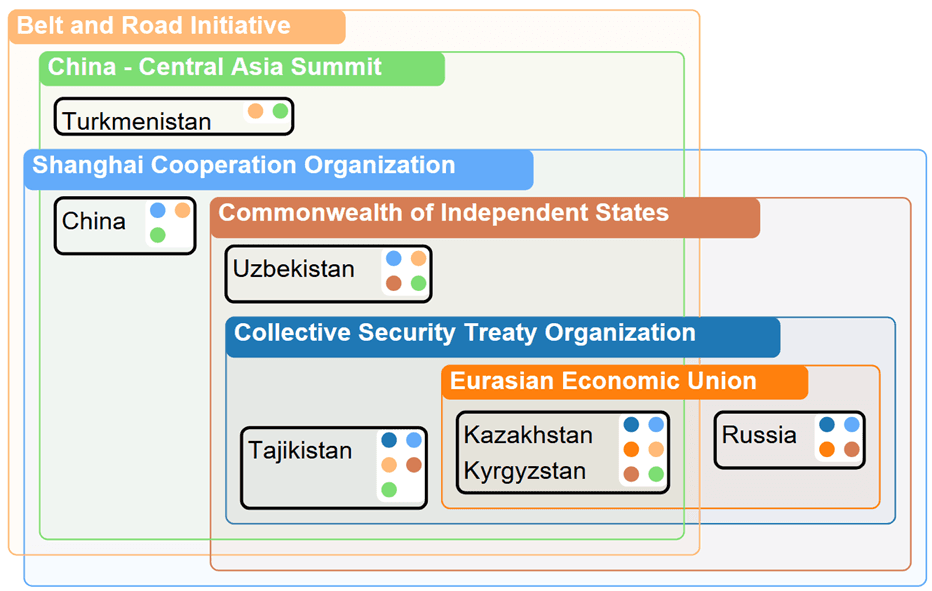
Membership of Russia and China to Central Asian multilateral institutions (image 1)
The role of Central Asian multilateral organizations in the PRC’s quest for security
The PRC’s domestic and foreign policy has been driven by a main imperative since its inception in 1949: territorial integrity and stability. The numerous calls to history in Xi Jinping’s slogan of “China dream” (中國夢, Zhōngguó Mèng), notably to the “century of humiliation”, reiterate this imperative (Andrieu, 2023, p. 69; Xiang, 2016). The PRC’s longing for security will only be reinforced in the years to come.
As the consequences of both the Russia-Ukraine war and the Covid-19 pandemic are strongly affecting the world stage, economic security is becoming increasingly more important. This “involves the creation of a network of sustainable economic corridors” (Papava, 2025, p. 3). This is perfectly embodied by the PRC. China’s network of sustainable economic corridors first took form as the BRI early in Xi Jinping’s term. There are three corridors connecting China to Europe (see picture 2):
The Northern Corridor, in purple, going through Kazakhstan, Russia and Belarus.
The Middle Corridor (also known as the Trans-Caspian), in pink, going through Kazakhstan, the Caspian Sea, Azerbaijan and Georgia, to reach Turkey or the Black Sea.
The Southern Corridor, in yellow, going through Central Asia, Iran and Turkey.
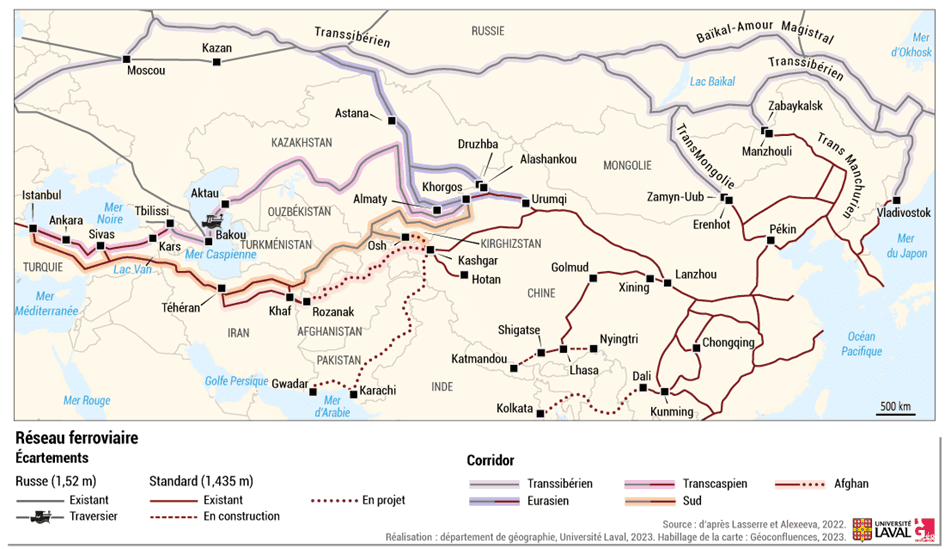
Railway corridors going through Central Asia in 2022. Source: département de géographie de l’Université Laval; Géoconfluences, 2023 (picture 2)
The BRI is symptomatic and probably the most striking example of a Chinese foreign policy heavily devoted to improving domestic security in multiple domains. China’s “charm offensive” on Central Asia through multilateral organizations can be tied to a few other reasons than simply economic security.
Xinjiang – the most unstable region of China – shares a 3300-km border with Kazakhstan, Tajikistan and Kyrgyzstan. The presence of 1.5 million ethnic Kazakhs, 180,000 ethnic Kyrgyz, 50,000 ethnic Tajiks, and 10,000 ethnic Uzbeks in Xinjiang (Umarov, 2020) makes Central Asian populations culturally and religiously connected to Xinjiang. China’s drive to maintain good relations with those countries highlights one of China’s most pressing domestic priorities: maintaining political unity.
Central Asia is also becoming increasingly relevant for China’s energy security as Beijing seeks to diversify its imports from Africa and the Middle East. It is home to Kazakh oil and uranium, Turkmen gas, and alternatives to maritime roads. 80% of the crude oil the PRC imports from the Middle East and Africa is carried through the strait of Malacca, a chokepoint the United States could potentially exploit in the case of a conflict (L. Yu, 2024, p. 219).
The massive untouched Central Asian reserves of rare earth elements also attract the attention of both Beijing and the rest of the world. Rare earth elements are a fundamental component of modern technology. Today, China holds approximately 48% of rare earth elements reserves and 69% of the production (Huld, 2025). Thus, Central Asia is of increasing geopolitical relevance in this sector as the PRC seeks to hold its overwhelming advantage, and other countries seek to diversify their supply.
Those issues, which are tied to vital national interests, are part of the reason why China is particularly active in Central Asian multilateral frameworks. It means that the PRC will most likely continue to further increase its presence there in the short and medium terms in order to safeguard fundamental interests.
What it means for Sino-Russian relations
The action of China in multilateral organizations is often understood through the lense of “contested multilateralism” (Yuan, 2023, pp. 425–426). It is described by the author as « the gap between institutional structures and changing power distribution » of states being translated into strategies to seek changes in – or the creation of – international organizations. The creation of the BRI and the C+C5, without Russia, might reflect this dynamic.
China’s action within the SCO and focus on economic matters with the BRI and C+C5, bring some nuance to the picture. As of now, it seems that Beijing attempts to reassure Russia that China’s growing influence in Central Asia will not contest Russia’s influence. The agreement between Russia and China to include Pakistan and India (2017), and Iran (2023) in the SCO shows a Chinese priority for regional stability and balancing, and willingness to compromise.
This situation might not last. Until recently, Russia held the role of security provider in Central Asia and China had limited herself to economic cooperation in the region. Russia’s assertive stance towards central Asian states in recent years and conflicting Sino-Russian views on the SCO’s mandate raises serious questions about the durability of the organization (Yuan, 2023, pp. 434–435). What is more, the CSTO credibility being questioned and limited action of the CIS reveals Russia’s waning credibility as a security provider, notably because of its need to funnel resources towards the war in Ukraine. On the other side, China develops cooperation with Central Asian countries across multiple areas and, more importantly, does it successfully. We can expect this trend to continue in the same direction since those areas – economic, energy, environmental cooperation – tie to core national priorities.
Beijing is also transparent about the limits of the Sino-Russian “no-limits partnership”. In 2016, Fu Ying, former Vice Minister of Foreign Affairs and Chair of the Foreign Affairs Committee of the National People’s Congress writes in Foreign Affairs that “Beijing and Moscow are close, but not allies”, that “the Sino-Russian relationship is a stable strategic partnership and by no means a marriage of convenience”, and that “changes in international relations since the end of the Cold War have only brought the two countries closer together” (Ying, 2016). More recently, in 2023, China’s ambassador to the EU said that “’no limit’ is nothing but rhetoric” (Stevis-Gridneff & Erlanger, 2023).
Conclusion and recommendations
As I heard from a foreign policy expert recently, “nowadays, every region of the world is strategic”. I would like that, nowadays, most international issues are interconnected. As such, whether one is concerned about the Russia-Ukraine conflict, growing tensions between the US and China in the Indo-Pacific, or international environmental and energetic security issues, they would do well to pay close attention to the evolutions of Sino-Russian multilateral interactions in Central Asia. Today’s evolutions are complex, show clear changes in the Sino-Russian relations but still have the potential to go in very different directions. In the near future, China’s and Russia’s interactions in the region is (Zhang, 2025):
a complex scenario of “coexistence of cooperation and confrontation”: the two will maintain strategic coordination at the macro level to counter Western pressure, while competition and friction in specific regions and domains will become regularized and more overt. These confrontations may primarily focus on control of infrastructure and trade routes, the power dynamics in energy cooperation, and the struggle for influence between China and Russia in Central Asia.
As a result, we have two recommendations for Western decision makers
Engage with Central Asia
Europe should look to have strong diplomatic ties with Central Asian countries in order to play the balancing game of the Eurasian crossroad. Whether it be to enjoy the region’s connectivity, secure resources, engage with or counteract Russia and China, it is necessary to have a presence in the region set to become the most important overland economic node.
Look closely at indicators of China’s involvement as a security provider
The PRC acquiring a more important role as a security provider in Central Asia would signal a fundamental shift in the Sino-Russian balance of power and a significant evolution of Beijing’s foreign policy strategy. Such a shift would not be confined to Central Asia and could have implications for China’s stance on the war in Ukraine and for security dynamics in the Indo-Pacific region.
Bibliography
Andrieu, P. (2023). Géopolitique des relations russo-chinoises. PUF.
Arynov, Z., & Umirbekov, T. (2025). Contesting the unknown? Public perceptions of the Collective Security Treaty Organization (CSTO) in Armenia, Kazakhstan, and Kyrgyzstan. Contemporary Security Policy, 46(4), 1197–1224. https://doi.org/10.1080/13523260.2025.2474868
Huld, A. (2025, August 29). China’s Rare Earth Elements: What Businesses Need to Know. China Briefing. https://www.china-briefing.com/news/chinas-rare-earth-elements-dominance-in-global-supply-chains/
Ministry of Foreign Affairs of the People’s Republic of China. (2023, May 19). 中国—中亚峰会西安宣言(全文)—中华人民共和国外交部. https://www.fmprc.gov.cn/zyxw/202305/t20230519_11080194.shtml
Papava, V. (2025). Transport Corridors of Central Asia – Facing the Challenges of Confrontational Globalization. SSRN Electronic Journal. https://doi.org/10.2139/ssrn.5189295
Sharifli, Y. (2025, June 25). Moving Beyond Infrastructure: Key Outcomes from the Second China-Central Asia Summit. The China-Global South Project. https://chinaglobalsouth.com/analysis/china-central-asia-cooperation-centers-soft-power/
Stevis-Gridneff, M., & Erlanger, S. (2023, April 5). China’s Ambassador to the E.U. Tries to Distance Beijing From Moscow. New York Times. https://www.nytimes.com/2023/04/05/world/europe/eu-china-embassador-russia-fu-cong.html
Umarov, T. (2020). China Looms Large in Central Asia. Carnegie Endowment for International Peace. https://carnegieendowment.org/posts/2020/03/china-looms-large-in-central-asia?lang=en
Xiang, L. (2016). Xi’s Dream and China’s Future. Survival, 58(3), 53–62. https://doi.org/10.1080/00396338.2016.1186978
Ying, F. (2016, January). How China Sees Russia. Foreign Affairs, 95(1). https://www.foreignaffairs.com/china/how-china-sees-russia
Yu, H. (2024). Understanding China’s Belt and Road Initiative (Vol. 26). Springer Nature Singapore. https://doi.org/10.1007/978-981-99-9633-9
Yu, L. (2024). China-Russia Partnership and the Shanghai Cooperation Organization (SCO). In L. Yu (Ed.), The Rise of China and the China-Russia Strategic Partnership (pp. 199–237). Springer Nature. https://doi.org/10.1007/978-981-96-0997-0_6
Yuan, J. (2023). Forging a New Security Order in Eurasia: China, the SCO, and the Impacts on Regional Governance. Chinese Political Science Review, 8(3), 422–439. https://doi.org/10.1007/s41111-022-00223-7
Zhang, W. (2025). The Belt and Road Initiative and the Eurasian Economic Union: Why cooperation not confrontation? Frontiers in Political Science, 7. https://doi.org/10.3389/fpos.2025.1721059
Emmanuel Hubert is a Belgian student specializing in geopolitics, security, and defense in the Indo-Pacific. He conducted research at the Royal Higher Institute for Defense on the implications of Sino-American rivalry for transatlantic relations and European security and defense architecture. Emmanuel aims to further develop his language skills, notably Chinese, to contribute to a more effective European strategy towards China and Asia.
https://www.linkedin.com/in/emmanuel-hubert-486440282/