

Executive Summary
In a context where the ‘strategic autonomy’ of the European Union (EU) is an imperative stemming from fracturing alliances and heightened uncertainty. This brief investigates the EU’s capacity to project power through innovation and technology. It focuses on the European Innovation Council (EIC) and, in particular, its ‘Pathfinder’ instrument, which is the primary European public avenue for early-stage deep technology ventures to obtain funding and find markets. This paper examines the EU’s innovation ecosystem's capacity to compete with great powers in an era where technological breakthroughs are transforming the nature of competition, war, and autonomy. By doing so, it observes the parameters that prevent the Union from developing groundbreaking technologies; namely, the scale of the instruments, the investment culture in Europe and the funding timeframe proposed by Pathfinder. Another aspect touched upon in this brief is the focus on the development of ‘dual-use’ technology as a consequence of external security incentives. This paper argues that, while it is necessary to develop the military deterrence of the Union, this focus acts as a force, shaping the investment market. The recent normative shift in Environmental, Social, and Governance (ESG) criteria de-stigmatized defence investing for private capital, which effectively attracts much-needed funds, but also incentivizes ventures to pivot towards combat-ready application prematurely to secure investment. This potentially prevents promising ventures that need patience on foundational research from reaching their full potential. In the present context, ventures find more funds when they demonstrate dual-use, while riskier but more rewarding projects are left to compete between themselves for commercialization. Therefore, the surge of investment in defence and innovation that the Union is seeing seems to facilitate short-term results rather than long-term strategic objectives. This is arguably consistent with a reactive posture rather than an anticipatory strategy. While the EU remains a fragmented Union sporting a regulatory-first approach, competitors’ innovation systems such as the American Defence Advanced Research Projects Agency (DARPA) and China’s Military-Civil Fusion (MCF) are characterized by a higher tolerance to risk and structures de facto integrating public-private partnerships. Therefore, despite the Union's increased spending, the current European deep technology ecosystem is inconsistent with the requirements of a highly competitive innovation environment because it lacks scalability, fosters zero-sum competition between unrelated projects, and facilitates access to accelerators to already de-risked ventures. This predicament reflects a ‘market-fixing’ mentality, where public funds merely fill gaps left by private capital. However, transformative technologies arguably require an ‘Entrepreneurial State’ (Mazzucato, 2011) to act as a lead investor, taking risks before the private sector is willing to engage. Therefore, this brief concludes on a recommendation that aims at transforming the most recent EIC tool, the Advanced Innovation Challenge, into a mission-oriented vehicle that can shape the market and proactively de-risk deep technology investments for private actors.
Background
In March 2025, the European Commission (EC) and the EU High Representative for Foreign Affairs and Security Policy published a White Paper on the future of European Defence: Readiness 2030. The paper presents the necessity for the European security posture to evolve. Driven, notably, by identified flaws such as the unpreparedness of its defence industry, the necessity for competitiveness in the technological realm, and the will to swiftly close this gap. This predicament is mainly informed by the identification of fundamental threats and actors who "are directly threatening our way of life and our ability to choose our own future through democratic processes." (European Commission, 2025a). Alongside this, deteriorating allyship, multi-vector threats, and the reality of high-intensity kinetic warfare on the Eastern flank further explain the urgency of this White Paper.
Crucially, this deteriorating external environment is driving a securitization of European innovation, where the imperative for immediate defence readiness increasingly prioritizes identifiable dual-use applications of innovation. In this context, European institutions developed roadmaps aimed at addressing the military unreadiness of the Union. This is represented by the ReArm Europe plan, the Security and Action for Europe (SAFE) instrument, and a surge in defence and R&D spending. Indeed, according to the European Defence Agency (EDA), the EU spent €381bn on defence and €17bn on defence R&D in 2025. This represents a 62.8% increase since 2020 (EDA, 2025). This reflects a reactive posture to the threats recognized by the Union. The current phase of the full-scale invasion of Ukraine exemplifies the decisiveness of technology used in combat and the utility of dual-use civilian innovations. Through a broader scope, this conflict represents a harbinger of what could happen on the European continent if Russia is not swiftly deterred. Hence, from the perspective of the EU, technology is a decisive aspect of power which impacts the character of war, and therefore, ought to impact the ecosystem of technological innovation for European defence industries. (European Commission, 2025a)
The global technology race, coupled with the security needs of our epoch, brings attention to the operationalization of Disruptive Emerging Technology (DET) as an essential aspect of modern warfare (European Commission, 2025b). Operationalization here means the viable use of a DET to reach strategic objectives such as superiority in defence, energy or computational power. In this context, the transition from research project to usable technology is fueled by sustained investment, extensive research and mission driven development. The term ‘innovation’ is intrinsically time-bound, as when a technology is mature and widely used, it loses its ‘innovative’ aspect. Defining deep technologies follows the same logic, as it is defined less by its essence and more by its practical challenges, which are mainly:
high information asymmetry, which means that future returns on R&D efforts are uncertain and that innovation is subject to a high rate of failure.
high capital intensity, which means that sustained investment is necessary from the beginning of the research to the commercialization of the technology (Agbiboa, 2022).
Therefore, as ventures integrate high failure rates and uncertainty on future returns, state intervention is often remedial to the shortcoming of private investments. In the case of the European ecosystem, if research funds in universities foster promising projects protected from the pressure of the market, transforming innovations into de-risked firms where Venture Capitalists will invest until production and commercialization is extremely tedious. This is what some scholars call the ‘European Paradox’, where the “EU countries play a leading global role in top-level scientific output, but lag behind in the ability to convert this strength into wealth-generating innovations” (Mazzucato, 2011). This effect might stem from cultural and structural aspects. Structurally, early stage projects are relatively well funded from private and public actors but lack an ‘Entrepreneurial State’ that will not only take risks but also provide mission-driven investments in risky sectors. Culturally, the Brussels standpoint that ‘if something is not written, then it is not allowed’ contrasts with, for example, the approach of Silicon Valley that considers that ‘if something is not written, then it is not forbidden’. This bureaucratic alignment limits the agility of the European innovation landscape and its ability to invest durably in high-risk and vision-driven projects.
In order to put this argument in perspective, a brief consideration of the strategic divergence between the European, Chinese and U.S. models seems appropriate. In the US, DARPA is a prime example of a ‘mission-driven’ agency. It operates independently, outside bureaucratic rigidity, with a high-calibre fiscality (4.37bn$ of budget in 2025). It uses a ‘moonshot’ approach where more than 100 programme managers invest in risky, ‘big bet’ programmes that have the capability to be groundbreaking technologies. The EIC, for example, funds thousands of projects that are competing to reach a commercial stage. DARPA is famous for world-making technologies such as the Internet (or ARPANET at the time of creation) and for using its technologies to nurture others projects, therefore cross-pollinating innovation (Bonvilian, 2024). China, on the other hand, operates through an integration model, the so-called ‘Military-Civil Fusion’, which by default considers that there is no boundary between civil and military innovations. Their model is state-led, with virtually unlimited funding, and all the intellectual property (IP) belongs to the state, which means that cross-pollination of innovation is extremely easy. This allows a centralized vision that pushes deep technology ventures in uncharted territories. A recent example of this is the creation of the world’s first Thorium to Molten Salt Reactor (TMLR) (Tripathi, 2025), which effectively uses molten salts for nuclear fission, hence bypassing the necessity for refined uranium. This project was abandoned by other states and arguably could not have emerged without a centralized governance on deep technology investment. Now, if this technology is operationalized and scaled, it could position China as a leader of green energy.
Despite the models of governance of these three entities being widely different, it seemed interesting to put in perspective the fact that the European Union, despite possessing a fantastic pool of talents, is working in an environment where risky investments and agility are features that remain hard to sport. Indeed, in the case of Europe, the aspects and requirements of deep technology that have just been discussed seem to sit at odds with the current security incentives of the Union. This is exemplified by the ‘dual-use’ by design notion, which stems from a reactive posture to external security pressures. This means that more than ever, the thinking going into projects necessitating patience to develop is affected by a sense of urgency to answer specific needs, and not creating new sectors that have not been thought of. In this context, the main public avenue for European civil deep tech investment, research, and scale-up is the EIC.
The European Innovation Council, established under Horizon Europe with a €10.1bn budget for 2021-2027, is Europe's primary civilian deep tech investor. It unlocked €1.4bn for 2026, and its mandate is to identify and support high-potential research and deep-tech ventures. When funding such research, the Technology Readiness Level (TRL) is used to assess the stage of development of a project. This is directly linked to the ‘risk’ involved in financing a venture. A TRL of 1 to 4 is typically early stage proof of concept, while a TRL of 7-9 is a technology with known use and ready to be commercialized. The EIC operates through three complementary instruments: Pathfinder (€262m) for early stage research (TRL 1-4); Transition (€100m), which bridges scientific stability with market readiness (TRL 3-6), and Accelerator (€634m) that provides finance for commercialization to mature projects (TRL 5-9). In 2025, the EIC launched a new instrument called the Advanced Innovation Challenge, allocating €6m in 2026 (€25m for 2027) for high-risk, high-reward deep tech projects, inspired by the American Advanced Research Projects Agencies (ARPA) model.
The current approach of European defence innovation funds, such as the European Defence Fund (EDF) or the EU Defence Innovation Scheme (EUDIS), is to invest in dual-use and R&D in sectors where defence application is already identifiable. Thus, adopting a situational alternative to the fact that game-changing technologies can not be foreseen at early research stages.
The current state of the EIC and its instruments is symptomatic of a ‘market-fixing’ approach. As Mariana Mazzucato (2011) argues, real strategic autonomy requires the EU to move beyond merely filling gaps left by private capital. The EU ought to act as an ‘Entrepreneurial State’, creating and shaping markets through bold, mission-oriented investments that accept high-risk and failure as a prerequisite for breakthrough innovation. The high barriers to entry in deep technology represent the price of being a relevant player in the innovation landscape. This sector requires a state to govern through the unknown, risk capital, accept failure and aim at long-term objectives. Hence, while the defence sector reactively empowers dual-use and disruptive technologies, civil innovations in deep technology pave the way for long-term strategic autonomy.
Policy Analysis
The EIC undeniably performs well in its mandate; the Impact Report 2025 (EIC, 2025) shows significant results, notably 700 companies supported, 150 ‘centaurs’ (€100M+ valuations), 8 unicorns, and €2.5bn of co-investment attracted since 2021. These strong financial metrics demonstrate the ability of the EIC to attract private investment and support a vast pool of deep tech ventures. However, despite these results, the impact on the strategic autonomy of the Union remains limited. Promising European firms still seem to get vacuumed into foreign ecosystems, and the prosperity of deep tech ventures within the EU remains an issue.
Several aspects of the EIC remain inconsistent with the ambition of nurturing a deep technology ecosystem capable of competing with great powers. Those aspects include the architecture, temporality, and scale of its main instruments. This part of the brief mainly analyses the Pathfinder instrument as the environment dedicated to early-stage projects, where risk and reward are the highest.
Firstly, Pathfinder provides a maximum of €4m per project for a total of €262m. In its pool, it accommodates ventures from various domains such as quantum computing, fusion energy, synthetic biology, advanced AI, novel materials, and clean energy technologies. While cross-pollination between domains can facilitate breakthrough innovations, the critical question here is whether the EIC’s current structure facilitates this kind of synergy. Rather than fostering intentional cross-domain collaboration, Pathfinder’s competitive model forces the aforementioned ventures to compete directly for the same limited funding pool. This contrasts with DARPA’s approach, where program managers actively connect projects to enable cross-pollination without forcing unrelated ventures into direct competition for resources. This form of zero-sum competition could be better managed, especially as it concerns TRL 1-4 ventures which are less likely to attract private investment.
The scale of Pathfinder further complicates this predicament. While a comparison with the American system bears its limits, it still hints at what type of scale is required by an ‘entrepreneurial state’ to lead investment in innovation. An American deep tech venture can receive 3 to 4 times Pathfinder’s maximum grant within a total budget that is 16 times larger. In the context of breakthrough technology development, from quantum computing to fusion energy, funding sustains not only initial research but also multiple stages of development that span years, if not decades. Moreover, projects in Pathfinder are subjected to a rather narrow timeframe. The data demonstrates a mean duration of 3.8 years, with 66% of projects clustered between 3 and 4 years. Deep tech projects typically require 7-15 years to reach commercial deployment, even in vastly more financed ecosystems.
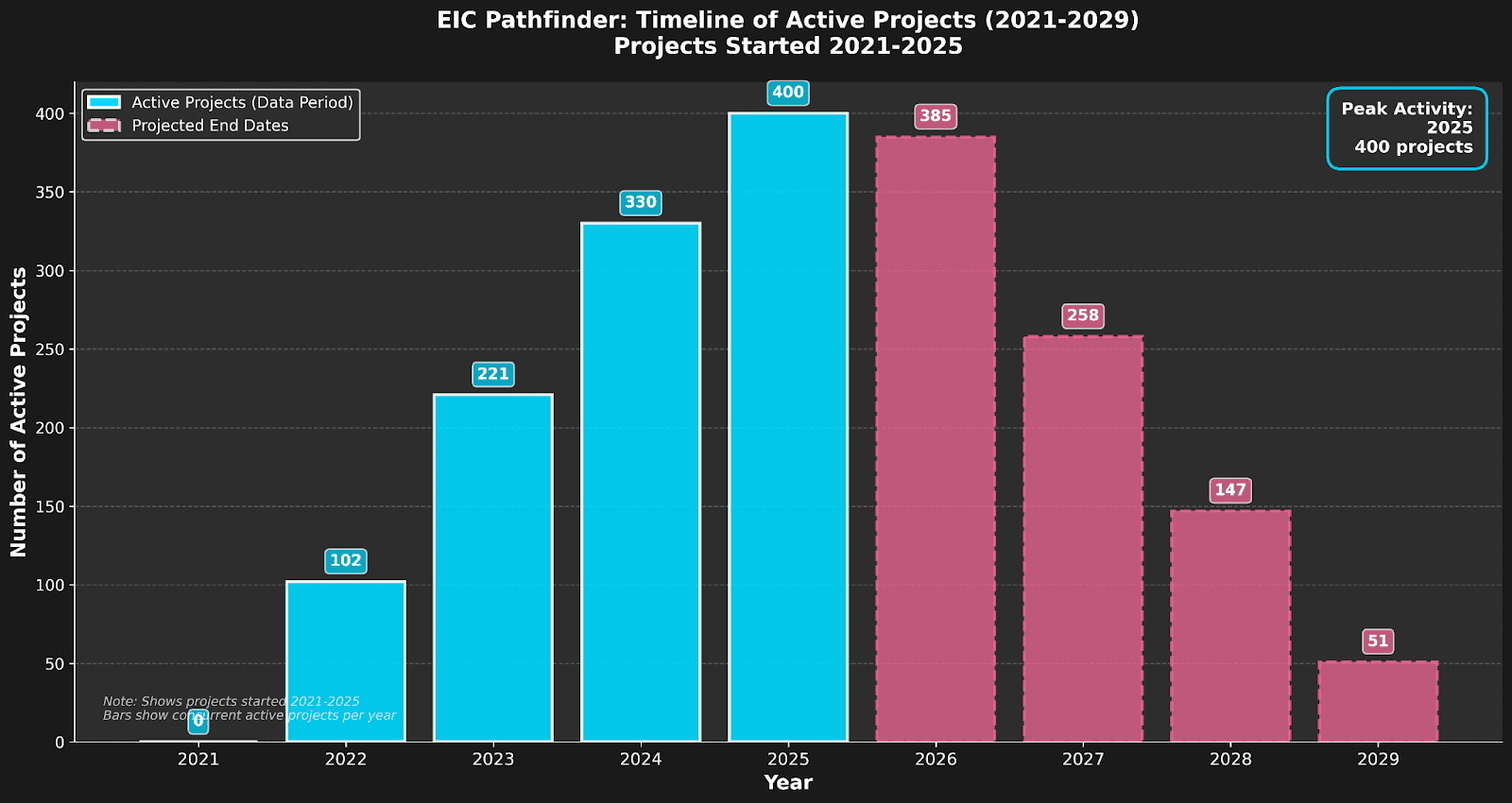
Fig. 1: EIC Pathfinder Timeline of Active Projects (2021-2029) - EIC Official Data
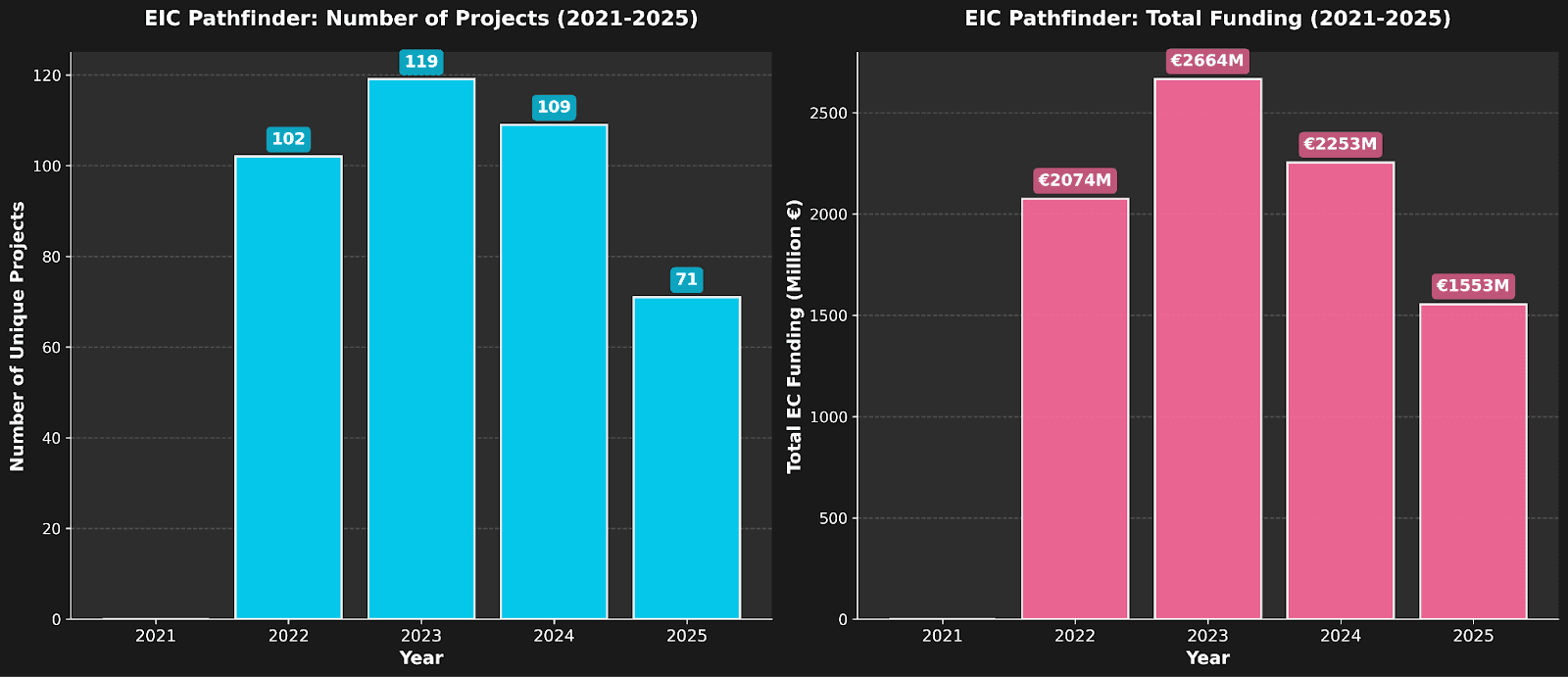
Fig.2: EIC Pathfinder: Number of Projects (2021-2025) - EIC Official Data
While Pathfinder may provide critical early-stage support that can be sufficient to reach a TRL above 4, it seems that European deep tech startups frequently exit the ecosystem through acquisitions by US or Chinese firms. Examples of AI ventures such as DeepMind (UK) bought by Google or Datakalab (FR) bought by Apple (Morris, 2024) demonstrate a recurring pattern where deep tech ventures struggle to remain in the European ecosystem. The risk-averse investment culture, coupled with insufficient follow-on funding mechanisms, means that even promising Pathfinder projects struggle to bridge the 'valley of death' between early research (TRL 1-4) and commercial readiness.
Moreover, deep tech stems from research that can often demonstrate technical viability, proof that a given scientific principle works, without yet having a defined end-use application. In this context, the surge of investment in dual-use technologies does not only overlook these types of ventures but also shapes the market. At early stages, it is unrealistic for deep tech ventures to demonstrate both civil and military use. Therefore, the ventures profiting from the surge in public funding towards dual-use are often already de-risked projects.
The bottleneck problem caused by the scale of Pathfinder shows that while a multitude of ventures are financed in early stages, real accelerators intervene past TRL 3-4. Therefore, because of the fragmented architecture of the EIC, ventures need to compete again at their most fragile stage. Indeed, through the ‘valley of death’, research funds are often terminated, public aid is not ensured, and private investment within Europe is hard to obtain as the venture has not found a market yet. It is an in-between space where competitors with better risk management skills acquire European firms and their IP to integrate them in competing ecosystems. Some accelerators fight against this phenomenon; this is the case for NATO's Defence Innovation Accelerator for the North Atlantic (DIANA), which helps de-risk ventures that can demonstrate a dual-use aspect. This NATO initiative, coupled with the NATO Innovation Fund (NIF), allows early-stage deep technology defence companies to approach investors and develop market-ready capabilities (Ricart, 2023).
This highlights a critical conundrum in the European ecosystem. While the world is becoming more dangerous, the vectors of threat multiply. Hybrid attacks using energy, cyber, data, information, or space are characterizing today's contingencies. Therefore, projecting power can be done using a vast array of tools with technology as the sole common denominator. This means that deep technology could be considered, to a certain point, ubiquitously dual-use. However, while trying to close the gap in combat-ready capabilities, the EU expressly focuses on 'dual-use by design' investments, undermining critical early-stage research with no known application. The Advanced Innovation Challenge, for example, while being a step forward, lacks the scale and exposure to risk required. This is especially alarming, knowing that high-potential technologies in competitors' ecosystems arise from architectures designed to tolerate failure, faith in entrepreneurs, decentralization from bureaucracy, and the cross-pollination of minds and innovations.
Recommendation: A sized private-public investment fund for high-risk deep technology ventures
The Advanced Innovation Challenge, albeit being a step in the right direction, is insufficient to rivalise with competitors’ instruments. The issue faced by the European deep technology industry is that few funding sources exist for high-risk TRL 1-4 ventures, and governments, as well as venture capital (VC) funds, are reluctant to invest before a technology is de-risked through demonstrable application. To address this issue, the EU ought to empower the Advanced Innovation Challenge by proposing to VC firms to invest in pools regrouping multiple high-risk projects with unknown applications. Venture capital typically seeks evidence of product-market fit or clear pathways to profitability, making it challenging to invest in projects with undefined applications. By grouping projects from unrelated fields (quantum computing, synthetic biology, novel materials, etc.) into single investment vehicles, the model transforms individual high-risk bets into managed portfolio risk, where breakthrough success in a few projects can generate returns across the entire pool. This approach also fosters the cross-pollination of expertise and unexpected synergies between domains that have historically driven radical innovation.
The Union would guarantee a major return on the investments and anticipate the failure of most of the projects. Specifically, the EU would provide downside protection by guaranteeing the return of 70-80% of private capital deployed, even in cases of project failure, while allowing VCs to retain 100% of upside gains from successful ventures. This asymmetric risk-reward structure, where the public sector absorbs most downside risk but the private sector captures full upside, creates incentives for VC participation in otherwise risky early-stage ventures. Therefore, the EU would ensure investors benefit from advantageous rates. This would heighten the capability of a high-risk governmental deep tech incubator while relieving pressure from Pathfinder and ensuring that the EIC continues its mandate steadily. Taking 10% of Horizon Europe’s annual budget, approximately €1.4b per year, would represent a meaningful scale-up. If the current EIC infrastructure managed to foster 3 times what it invested in private investment, a model where the state spearheads investment could have a market-shaping force. This commitment aligns with calls in the Draghi Report and the Commission's Competitiveness Compass for dramatically increased innovation investment, particularly as the next Multi-Annual Financial Framework (2028-2034) is expected to prioritize European competitiveness and strategic autonomy in deep technology sectors. This would address the issues of scalability in deep tech investment while propagating the culture of necessary risk and failure safely for VC funds.
It is critical to consider that the success rates for breakthrough technologies are low, R&D is expensive, and will fail. Arguably, the price of dragging behind major international players is known to Europe. This led to the current posture of strategic reactivity and not autonomy. Real autonomy and leadership ought to be grown from bold investments, cooperation with the private sector, and most importantly, faith in the European talent pool.
Bibliography
Agbiboa, M. L. 2022. What Is “Deep Tech” and What Are Deep Tech Ventures? MIT. https://reap.mit.edu/assets/What_Is_Deep_Tech_MIT_2022.pdf
Bonvillian, William B. 2024. Pioneering Progress: American Science, Technology and Innovation Policy. The MIT Press. https://doi.org/10.7551/mitpress/15450.001.0001.
European Innovation Council. 2025. EIC Impact Report 2025: EIC on Track as Leading Deep-Tech Investor, Mobilising €2.6 Billion of Additional Investment. April 3. https://eic.ec.europa.eu/news/eic-impact-report-2025-eic-track-leading-deep-tech-investor-mobilising-eu26-billion-additional-2025-04-03_en
European Commission. 2025a. White Paper for European Defence Readiness 2030. March 19. https://commission.europa.eu/document/download/e6d5db69-e0ab-4bec-9dc0-3867b4373019_en?filename=White%20paper%20for%20European%20defence%20%E2%80%93%20Readiness%202030.pdf
European Commission. 2025b. EU Defence Industry Transformation Roadmap: Unleashing Disruptive Innovation for Defence Readiness. November 19. https://defence-industry-space.ec.europa.eu/document/download/513de692-d08c-40cc-80c3-cb6611ace178_en?filename=EU-Defence-Industry-Transformation-Roadmap.pdf
European Defence Agency. 2025. Official Website. Accessed 26 Feb. 2026. https://www.eda.europa.eu/
Mazzucato, M. 2011. The Entrepreneurial State. London: Demos.
Morris, C. 2024. “Apple Quietly Beefs up Its AI Division with Acquisition of French Startup”. Fast Company. April 22. https://www.fastcompany.com/91110830/apple-datakalab-acquisition
Ricart, R. J. 2023. NATO Defence Innovation and Deep Tech: Measuring Willingness and Effectiveness. Carnegie Endowment for International Peace. https://carnegieendowment.org/research/2023/08/nato-defense-innovation-and-deep-tech-measuring-willingness-and-effectiveness
Tripathi, A. 2025. “China Achieves Thorium Fuel Conversion for Advanced Molten-Salt Reactor”. Interesting Engineering. November 1. https://interestingengineering.com/energy/china-thorium-fuel-conversion-molten-salt-reactor
About the Author
Stanislas Yahi is an independent researcher focused on the intersection between humanity, technology and power. He holds a BA in International Relations from Goldsmiths University of London and an MA in Global Security and Strategy from the Brussels School of Governance. Stanislas employs a mixed-methods approach, utilizing investigative instruments combined with scientific digital methods. His expertise in Russian propaganda and cognitive warfare led him to work as a researcher at the Centre for Digitalization, Democracy and Innovation (CD2I) in Brussels. Stanislas focuses his research on democratic resilience and hybrid warfare; he is also developing OSINT tools and all-source investigation methods. Stanislas can be contacted through his LinkedIn.