
The Arctic’s undersea domain is emerging as a critical and contested frontier for Canadian national security. Receding ice, expanding critical undersea infrastructure, and growing economic interest in energy, minerals, and fisheries are transforming the region into an arena of strategic competition.
Given this potential in the coming decades, Canada’s adversaries will seek to exploit this environment through new technologies, leading to more innovative grey-zone operations that will threaten infrastructure and erode sovereignty below the threshold of conventional conflict. To get ahead of this curve, Canada must strengthen undersea domain awareness, invest in scalable and cost-effective capabilities, and establish coordinated governance through a unified national forum.
As seen elsewhere in the world, the subsurface and seabed frontier is experiencing a boom in critical undersea infrastructure (CUI), including undersea fibre-optic cables, offshore oil rigs, gas pipelines, and submarine power cables (J. Kim, H. Kim, and Terasawa, 2025). Whether used for financial flows, governmental, diplomatic, and military communications, or the extraction and distribution of energy, CUI serves as a strategic instrument of statecraft in a more digitized and interconnected world.
The undersea domain is also witnessing growing economic interest due to new technologies and equipment to explore offshore energy, extract critical minerals and rare earth elements (REEs), and access greater fishing stocks.
With these new developments at hand, the Arctic will see profound impacts by Arctic and non-Arctic states that seek to exploit the region in the decades ahead. Thus, to understand the corresponding threats emerging from the undersea area, Canada must contextualize the domain’s environment within its Arctic security interests.
The Undersea Domain in Canada’s Arctic Security Context
As the region becomes more accessible seasonally and potential year-round travel becomes more feasible due to receding ice sheets, the Arctic’s geography is increasingly being looked at for new entry or exit points for countries and non-state actors seeking alternative trade and energy routes (Erskine, 2026). Central to the Arctic’s appeal is its means to mitigate geopolitical shocks and sidestep critical chokepoints in the Indo-Pacific, Central America, Europe, and the Middle East.
In the Canadian Arctic, the Northwest Passage (NWP) sits at this intersection of growing interests. As one of three major Arctic routes–alongside the Transpolar Sea Route that passes directly through the center of the Arctic Ocean and Russia’s Northern Sea Route–this maritime corridor will offer drastically reduced geographical distance to better connect the Pacific and Atlantic communities in the decades to come.
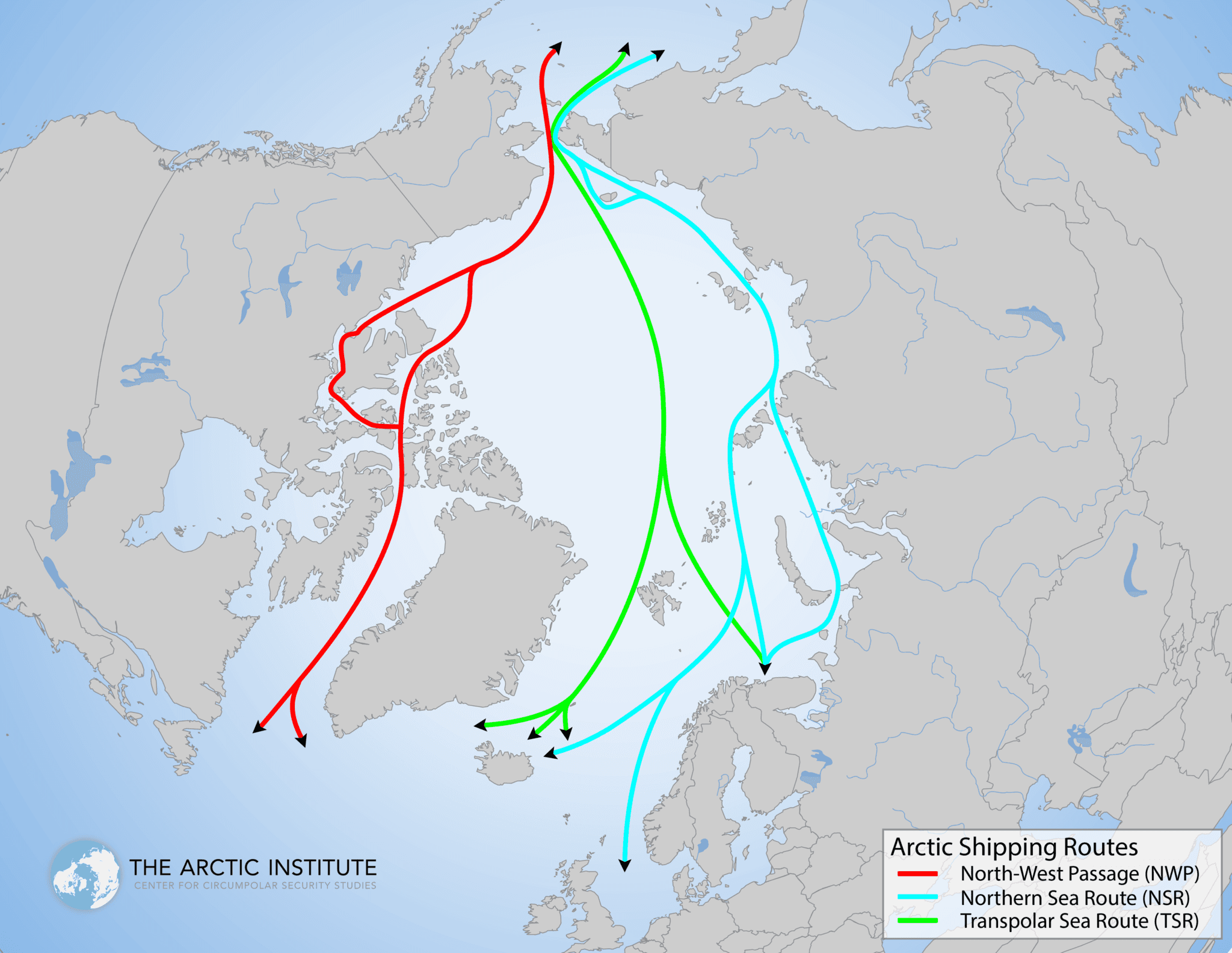
Map showing the Northern Sea Route, the Northwest Passage and the Transpolar Sea Route. Map: The Arctic Institute. (Humpert, 2011).
International attention has already led to Far North Fibre, a 14,000-kilometer cable stretching from Norway through the NWP and the Bering Strait to Japan (Far North Fiber, 2026). The cable seeks to reshape global connectivity between Europe and Asia by 2027.
Domestically, the NWP will also be crucial for Ottawa’s plan to build up Indigenous and local communities in the north with modern energy and connectivity infrastructure, as well as link the region with the southern Canadian populace. Canada has already earmarked $4 billion for undersea investments through different infrastructure, broadband, and telecommunication funds that have contributed to several projects currently underway in Kativik, Quebec (Eastern Arctic Underwater Fibre Optic Network), and Nunavut (CanArctic Inuit Networks) (Dalziel, 2024).
Moreover, the Arctic’s undersea domain will have a critical role in the geoeconomics of the mid-to-late 21st century (Erskine, 2025). According to a 2008 U.S. Geological Survey, the Arctic holds an estimated 13% of the world’s undiscovered conventional oil resources – which equates to 90 billion barrels – and an estimated 30% of undiscovered conventional natural gas resources (Gautier et al., 2008). In a similar geological survey launched by Natural Resources Canada in 2022, the Canadian Arctic Archipelago contains an array of high, medium, and low hydrocarbon potential that can account for over 1 billion barrels of oil and trillions of cubic feet of gas (Natural Resources Canada, 2022).
While very little exploration has been undertaken to survey possible deposits of critical minerals and REEs on the seabed of the Canadian Arctic, contemporary studies and global marine geology point to three plausible types – polymetallic nodules (nickel, copper, and manganese), cobalt-rich ferromanganese crusts (cobalt, platinum, and other REEs) and other hydrothermal deposits like gold, copper, silver, and lead (Hein and Mizell, 2022).
All of these minerals are essential for technologies needed for renewable energy technology, electric vehicle batteries, advanced military hardware and software, and telecommunications.
Lastly, as the waters in the Arctic warm, Canada’s northern region will see more international fishing operations near or within its Exclusive Economic Zone (EEZ). Aside from the marine implications a warmer Arctic will have on indigenous fish stocks or the consequences posed by new migratory routes of non-indigenous fish, new geopolitical challenges will emerge that will link fishing and security closer together as a result of Illegal, Unreported, and Unregulated (IUU) fishing (Evansa and Østhagen, 2023).
The Arctic’s undersea domain presents both opportunity and risk that must be seriously considered should Canada want to advance its national security interests in the Arctic. By failing or hesitating to anticipate how this new domain will impact Canada’s political, military, and diplomatic dynamics, Ottawa risks ceding strategic advantage to adversaries seeking to capitalize on the region’s resources.
Grey-Zone Threats in the Subsurface and Seabed
Conventionally, Canada has used the Royal Canadian Navy’s (RCN) submarine capabilities and the Air Force’s long-range maritime patrol aircraft to respond to threats in the undersea domain.
While these platforms have an extensive role in shaping and projecting future Canadian maritime power into the Arctic, Ottawa must prepare for and respond to low-intensity and irregular security threats that amplify an adversary’s undersea capabilities in the Arctic.
Termed grey-zone operations, these activities see states – alongside their state-owned enterprises, fishing and commercial fleets, scientific and research ships, or coast guard and militia organizations – conduct illicit maneuvers and actions aimed at disrupting or damaging key assets and eroding sovereignty claims of an opponent without crossing the legal threshold of military action.
As the Canadian Arctic becomes more accessible and hospitable to greater international traffic for laying CUI, fishing, resource and mineral exploration and extraction, Ottawa should anticipate heightened frequencies of grey-zone threats. As it relates to the geoeconomic potential of the Canadian Arctic, Ottawa should anticipate an increased risk of seabed infrastructure sabotage and espionage in the decades ahead.
In these situations, ships belonging to a civilian or shadow fleet, or under an umbrella company of a malevolent state actor, may drag their anchor or bottom trawl fishing equipment across the seafloor to damage CUI. Russian and Chinese vessels have already been suspected of carrying out these forms of operations in the Baltic Sea in recent years, most notably causing disruptions with the BCS East-West Interlink and C-Lion1 fibre-optic cables (Braw, 2024; CBC, 2025).
These operations serve multiple strategic ends. For one, they demonstrate the success of low-intensity and irregular forms of belligerent activity to deter countries from taking specific actions that hinder Moscow’s or Beijing’s geopolitical interests. Moreover, they can cause new challenges that require time, money, and consensus to resolve, most notably repairing CUI and instituting new laws that mitigate the legal ambiguities of illicit undersea activities.
Yet in the years to follow, it should be expected that technological advances in autonomous undersea vehicles (AUVs) and unmanned underwater vehicles (UUVs) will see more innovative grey-zone operations on the seabed against CUI in the Arctic. In particular, AUVs and UUVs could undertake sabotage missions against CUI – notably telecommunication and submarine power cables – at depths that would make repair extremely difficult, if not impossible, due to keeled sea ice, erratic underwater currents and a limited availability of repair ships and operators. Such an incident occurred in January 2022 when the Svalbardfiberen cable – a fiber optic connecting the Svalbard Satellite Station with mainland Norway – was damaged. While the cable was only partially damaged due to a suspected sabotage effort, it took 18 months to fully repair the cable as a result of limited numbers of cable repair ships and operators (Conley, Arts, Berzina, and Rintakumpu, 2024).
Moreover, with the move towards Science Monitoring and Reliable Telecommunications (SMART) cables – CUI capable of generating real-time data from sensors embedded into the fibre-optic cables – espionage operations would see drones more readily hack or interfere with the cables for intelligence purposes (Dombrowski and Jones, 2025). Lastly, UUVs and AUVs embarking on sabotage or espionage missions can also carry out simultaneous operations to monitor, gather, and assess undersea data. The purpose of these operations will be to unveil the military strengths and weaknesses of Canada’s defensive posture in the waters under the Arctic.
In the future, advancements in UUVs and AUVs could lead to more unconventional military operations. Specifically, these platforms can traverse along the seabed, outside or inside Canada’s northern maritime boundaries, to launch missiles or aerial and maritime drones aiming to reduce or deplete the CAF’s response capacity in the Arctic, devastate energy infrastructure along the Arctic’s inhabited coastal regions, or cripple key Canadian industrial and technological manufacturing capabilities located further on the mainland.
The strategic problem that emerges with the scope and scale in which an adversary can execute these operations rests in the dual-use nature of AUVs and UUVs. Because these vehicles are heavily incorporated into Russian and Chinese armed forces, merchant, scientific, coast guard, or commercial fleets, it is difficult to assess whether Moscow or Beijing are conducting nefarious activities aimed deliberately to undermine Canadian national security interests in the Arctic or for non-military missions which range from mapping the seabed, repairing and replacing CUI, search and rescue missions, or broader scientific-based research missions (Aliyev, 2026; du Fretay, 2025).
Without having a sustainable, scalable, and consumable capability to investigate and respond to such activities, distinguishing legitimate from hostile operations in or near Canada's Arctic EEZ will become operationally untenable.
Policy Recommendations
Recognizing the new frontier in Arctic security, Ottawa has begun to adjust its force posture to enhance forward presence operations and surveillance capabilities. With plans to procure 12 submarines, Ottawa has also announced plans to establish four new Arctic long‑range marine radar sites along the Northwest Passage and the Hudson Strait and to acquire short- and medium-range endurance subsurface drones to extend the reach of the Canadian Coast Guard (CCG) to strengthen Canada’s Arctic maritime domain awareness (Canada, 2026).
Yet these investments should not be the ceiling, but rather the floor for amplifying Canada’s Arctic maritime domain awareness. As such, Canada must proceed in procuring more platforms and equipment that can sustain longer forward presence operations and guarantee more concrete persistence to detect, monitor, and respond to conventional and grey-zone threats emerging underneath the waters of the Canadian Arctic.
Central to this endeavor is the need for more UUVs and AUVs capacity in the RCN and CCG fleets. Specifically, Ottawa will need to integrate these platforms with advanced technologies like quantum sensors, cloud-based data collection, subsea analytic software, underwater robotic systems, and artificial intelligence and machine learning (AI/ML) capabilities to improve Canada’s subsurface and seabed awareness, and response and detection capacity in the Arctic.
Ottawa will also need to pair these platforms with a more extensive surveillance and monitoring network through the use of floating buoys to further enhance Canada’s dual-use detection capabilities to monitor, anticipate, and respond to threats occurring below the Arctic’s surface (Dalziel, 2024).
Before launching an ambitious funding stream for these technologies, procurement decision-makers need to understand a core requirement: these platforms, software, and equipment must be scalable, adaptable, and expendable. Put simply, they should not be exquisite. They must be cost-effective, manufacturable at scale in both peacetime and wartime, and treated as disposable — given the harsh operational environments they will face, the varying intensity of missions they will undertake, and the real likelihood that they will be lost, damaged, or need replacement.
Canada must also develop a centralized vessel repository tracking Russian shadow fleet ships and Chinese state-owned civilian, commercial, and fishing vessels with a history of — or credible suspicion of involvement in — grey-zone operations. It will be crucial for Canada to work with NATO and Indo-Pacific allies to cast a wider network that tracks vessels undertaking illicit activities to enhance deterrence by detection (Dombrowski and Jones, 2025).
From here, Ottawa should direct further attention to the repository by designing systems that can record not only vessel identities but also the specific locations and timeframes in which these ships operate when incidents occur across the Canadian Arctic. This will build an evidentiary baseline for future enforcement operations to legally inspect, board, or follow ships of interest.
Lastly, the undersea domain cannot remain fragmented across various Canadian departments that set out their own mechanisms for setting priorities. Therefore, Ottawa should establish a National Arctic Security Council (NASC) that is chaired by the Prime Minister and brings together the Department of National Defence (DND), Global Affairs Canada, Transport Canada, territorial governments, and Indigenous partners under one forum (Erskine and Landry, 2026).
In doing so, Ottawa can better coordinate intelligence, signal clear technological needs to industry, manage crises, and ensure unified government decision-making on the Arctic’s undersea domain. The NASC will ensure greater executive authority and capacity to implement stronger policies and accountability while providing more resources and flexibility for DND and the RCN to focus on overseeing and performing operational duties in the undersea domain.
Conclusion
Threats in the Canadian Arctic can no longer be dismissed due to geography or climate. Technological advances are enabling adversaries to exploit the undersea domain through low-cost, ambiguous, and unconventional methods.
At the same time, increasing economic and strategic interest is making the region more accessible and contested. Canada must move beyond traditional security assumptions and adopt a forward-looking approach that anticipates grey-zone operations and dual-use threats. Failure to do so risks Canada falling behind at a time when its ability to deter and detect threats in a contested Arctic is central to national security.
References
Aliyev, Nurlan. 2026. "Russia's Expanding Robotic Sea Capabilities." Center for Maritime Strategy, March 26. https://centerformaritimestrategy.org/publications/russias-expanding-robotic-sea-capabilities/.
Braw, Elisabeth. 2024. "Suspected Sabotage by a Chinese Vessel in the Baltic Sea Speaks to a Wider Threat." New Atlanticist (blog). Atlantic Council, November 21. https://www.atlanticcouncil.org/blogs/new-atlanticist/suspected-sabotage-by-a-chinese-vessel-in-the-baltic-sea-speaks-to-a-wider-threat/.
Canada. Canadian Coast Guard. 2026. "Minister McGuinty Announces $816 Million Investment to Strengthen Canada's Maritime Security." News release. May 22. https://www.canada.ca/en/canadian-coast-guard/news/2026/05/minister-mcguinty-announces-816-million-investment-to-strengthen-canadas-maritime-security.html.
CBC News. 2025. "Russian-Linked Ships Are Suspected of Sabotage in the Baltic Sea. Some Say It May Be Just the Beginning." January 8. https://www.cbc.ca/news/world/baltic-sea-ships-sabotage-1.7425968.
Conley, Heather A., Sophie Arts, Kristine Berzina, and Frida Rintakumpu. 2024. “Protecting Undersea Infrastructure in the North American Arctic: Lessons from Incidents in the Baltic Sea and High North.” German Marshall Fund of the United States, May. https://www.gmfus.org/sites/default/files/2024-10/Protecting%20Undersea%20Infrastructure%20in%20the%20North%20American%20Arctic.pdf
Dalziel, Alexander. 2024. "Critical Resilience: Russia, Hybrid Threats, and Subsea Fibre-Optic Cables in Canada's Arctic." Macdonald-Laurier Institute, June 20. https://macdonaldlaurier.ca/critical-resilience-russia-hybrid-threats-and-subsea-fibre-optic-cables-in-canadas-arctic/.
Dombrowski, Peter & Jones, Bruce. 2025. "A New Era of Undersea Conflict Is Here: Enhanced deterrence will require focused American action." Foreign Policy, March 21. https://foreignpolicy.com/2025/03/21/undersea-cables-sabotage-hybrid-conflict-deterrence/.
du Fretay, Halna. 2025. "Philippine Coast Guard Says Suspected Chinese Underwater Drone Recovered off Palawan." Army Recognition, October 2. https://www.armyrecognition.com/news/navy-news/2025/philippine-coast-guard-says-suspected-chinese-underwater-drone-recovered-off-palawan.
Erskine, Andrew. 2025. “A New Arctic Archipelagic Defence Concept Will Project Canada’s Power in the North.” The Hill Times, June 26. https://www.hilltimes.com/2025/06/26/a-new-arctic-archipelagic-defence-concept-will-project-canadas-power-in-the-north/465025/
Erskine, Andrew, and Alexander Landry. 2026. "Forging an Arctic Security Strategy: Why Canada Needs a Coherent Framework Now." CDA Institute, March 18. https://cdainstitute.ca/forging-an-arctic-security-strategy-why-canada-needs-a-coherent-framework-now/.
Erskine, Andrew. 2026. “The Strategy Gap—Why the U.S. Must Deter Russia and China in the North Pacific.” Pacific Forum, The Pilot 29. May 1. https://pacforum.org/publications/the-pilot-29-the-strategy-gap-why-the-us-must-deter-russia-and-china-in-the-north-pacific/
Evans, Grace, and Andreas Østhagen. 2023. "In Hot Water: Arctic Fisheries as a Proxy for Geopolitical Tensions." Commentary. Royal United Services Institute, July 11. https://www.rusi.org/explore-our-research/publications/commentary/hot-water-arctic-fisheries-proxy-geopolitical-tensions
Far North Fiber. "Home." Accessed May 27, 2026. https://www.farnorthfiber.com/
Gautier, Donald L., et al. 2008. "Circum-Arctic Resource Appraisal: Estimates of Undiscovered Oil and Gas North of the Arctic Circle." U.S. Geological Survey Fact Sheet 2008-3049. Reston, VA: U.S. Geological Survey. https://pubs.usgs.gov/fs/2008/3049/
Hein, James R., and Kira Mizell. “Deep-Ocean Polymetallic Nodules and Cobalt-Rich Ferromanganese Crusts in the Global Ocean.” 2022. In The United Nations Convention on the Law of the Sea, Part XI Regime and the International Seabed Authority: A Twenty-Five Year Journey. Leiden: Brill. https://doi.org/10.1163/9789004507388_013
Humpert, Malte. 2011. “The Future of the Northern Sea Route - A “Golden Waterway” or a Niche Trade Route.” The Arctic Institute, September 15. https://www.thearcticinstitute.org/future-northern-sea-route-golden-waterway-niche/
Kim, Jeehye, Hyun Kim, and Mei Terasawa. 2025. "The World's Subsea Cables Are Under Threat. Can Canada Help Protect Them?" Asia Pacific Foundation of Canada, May 16. https://www.asiapacific.ca/publication/worlds-subsea-cables-are-under-threat-can-canada-help.
Natural Resources Canada. 2022. “Hydrocarbon-potential map of the Canadian Arctic Archipelago and northern offshore areas”. Ottawa: Natural Resources Canada. Geological Survey of Canada, Open File, 8884, 5. https://doi.org/10.4095/329968
About the Author
Andrew Erskine is a Research Fellow at the Institute of Peace and Diplomacy, a Fellow at the Canadian Maritime Security Network (CMSN), and a Non-Resident Vasey Fellow with the Pacific Forum. Andrew’s work focuses on Canadian defence, security and foreign policy as it relates to the Arctic, North America, the Indo-Pacific, and NATO.